top of page

A parquet floor is not merely a decorative surface; it is a structural investment in your property’s heritage that requires master-level joinery rather than standard floor fitting. You likely recognise that a precision-cut pattern represents the pinnacle of interior elegance, yet the prospect of poor-quality workmanship leading to gaps or lifting often creates significant anxiety. It is equally common to worry about the invasive dust and disruption that typically characterises such a project. We believe that the journey to a magazine-quality home should be as refined and professional as the final aesthetic outcome.

In this master craftsman’s guide, you will discover how to achieve a flawless, high-end finish with our specialist parquet floor installation Swansea service. We provide the expert design advice needed to select patterns that complement your room's unique proportions whilst ensuring your home remains pristine through advanced dust-free technology. We will explore the essential material selections suited for the South Wales climate and detail the technical processes that guarantee a lifetime of durability. By the end of this article, you will have a clear roadmap to securing a bespoke floor that serves as a stunning, long-term centrepiece for your home.

Table of Contents

The Timeless Appeal of Parquet Flooring in Swansea Homes

Parquet flooring has enjoyed a significant resurgence in South Wales, particularly amongst homeowners undertaking sympathetic restorations of period properties. The Timeless Appeal of Parquet Flooring lies in its ability to marry historical gravitas with contemporary durability. For those considering a bespoke parquet floor installation Swansea offers a wealth of architectural backdrops, from the high ceilings of Victorian villas to the sleek lines of modern waterfront apartments. A well-chosen pattern does more than just cover a subfloor; it directs the eye and creates a sense of rhythmic movement that can make a compact hallway feel significantly more expansive.

Beyond the immediate aesthetic impact, real wood parquet serves as a structural investment. Unlike temporary floor coverings, a master-fitted parquet floor adds tangible long-term value to South Wales properties. We often find that clients are looking to balance this traditional craftsmanship with modern requirements, such as underfloor heating. By utilising high-quality engineered timber, we can achieve the classic geometric look whilst ensuring the floor remains stable and efficient under varying temperatures. This intersection of heritage design and modern technology is where true floor fitting expertise becomes essential.

Matching Parquet to Swansea Architectural Styles

The choice of pattern should always be informed by the property's soul. In the grand hallways of Uplands and Sketty villas, Herringbone remains the gold standard. Its interlocking blocks provide a formal, sophisticated arrival that honours the original proportions of these suburban homes. Conversely, for contemporary waterfront developments in Swansea Marina, Chevron patterns offer a sharper, more linear aesthetic. This style excels in minimalist interiors where the play of coastal light can highlight the precision of the mitred joints. For rural Gower cottages, we often recommend aged oak blocks to reclaim the rustic character that may have been lost during previous renovations.

The Longevity of Real Wood vs. Laminate Alternatives

While mass-produced laminate or LVT might appear cost-effective initially, they are ultimately disposable products. Real wood parquet is a multi-generational asset. A professional parquet floor installation Swansea project allows for the surface to be sanded and refinished multiple times over several decades. If the finish becomes worn or your interior style changes, the wood can be restored to its original lustre rather than being sent to a landfill. Choosing sustainable timber also ensures your project aligns with the 2026 trend for "conscious flooring," reducing the environmental footprint of your home whilst providing a surface that only gains character with age.

Choosing Your Pattern: Herringbone, Chevron, and Versailles

Selecting a pattern is a decision that dictates the architectural narrative of your home. In coastal Swansea properties, the direction of natural light is a critical factor. Morning light from the Bristol Channel can transform the appearance of wood grain, making the orientation of your parquet blocks as important as the material itself. A master-level foundation of excellence ensures that the chosen pattern aligns with the room's primary light source to avoid unwanted shadows or glare. We consider every angle to ensure the geometry enhances the room’s natural flow.

The Herringbone Classic

Herringbone remains the most sought-after choice, accounting for approximately 30.1% of flooring products in the UK market in 2026. It's incredibly versatile. Traditional herringbone uses single blocks, whilst double-herringbone creates a more textured, intricate surface by pairing the blocks. In narrow Swansea terraced hallways, laying herringbone at a 45-degree angle to the walls can create a visual illusion of width, making the space feel less constricted. This pattern provides a sense of movement that directs the eye through the property, establishing a cohesive aesthetic from the entrance onwards.

Chevron and Basket Weave

Chevron is often mistaken for herringbone, but its blocks are cut at an angle to meet in a perfect point, creating a continuous "V" shape. This requires extreme precision during the parquet floor installation Swansea process; even a millimetre of error can disrupt the entire room's symmetry. It offers a high-end Parisian aesthetic that works beautifully in modern South Wales renovations. For more traditional spaces like libraries or home offices, the basket weave pattern provides a subtle, woven texture that pays homage to classic joinery. It's a sophisticated choice for rooms where a quieter, more understated floor is required.

Proportion is everything. Large blocks can overwhelm a small Victorian parlour, whilst tiny blocks may look cluttered in a large open-plan kitchen. We often recommend using custom borders or "aprons" to define specific zones within open-plan living areas. This framing technique provides a finished, professional look that separates the dining area from the lounge without the need for physical partitions. If you are unsure which geometry best suits your property, our team can provide bespoke design guidance tailored to your room's specific dimensions and light levels.

Why Sub-Floor Preparation is the Foundation of Excellence

The structural integrity of your new floor depends entirely on what lies beneath it. Whilst the geometric beauty of the wood is what you see, the precision of a parquet floor installation Swansea project is won or lost during the sub-floor preparation phase. If the base is uneven or damp, even the finest oak blocks will eventually lift, gap, or squeak. We treat this stage with the same meticulous attention as the final polish, ensuring the sub-floor is clean, dry, and structurally sound before a single block is laid. Primers are vital here; they consolidate the surface and ensure a chemical bond between the sub-floor and the adhesive, preventing the peeling effect that occurs when wood is glued directly to dusty or porous screeds.

Moisture testing is a non-negotiable requirement in the humid climate of South Wales. Wood is a hygroscopic material, meaning it absorbs and releases moisture from the air and the sub-floor. Failure to install a high-quality damp-proof membrane (DPM) or verify that concrete screeds are fully cured can lead to catastrophic expansion. Following The Professional Installation Process means using calibrated hygrometers to confirm that moisture levels are within the strict tolerances required for a lifetime of stability. We never rely on guesswork; we rely on data to protect your investment.

Dealing with Concrete and Floorboards

In modern Swansea developments, we typically work with concrete or liquid screeds. These must be mechanically ground to remove laitance and then levelled with high-strength smoothing compounds to achieve the SR1 flatness standard. This standard allows for no more than a 3mm deviation over a 2-metre straight edge, providing the "flatness" required for geometric precision. In older Victorian villas, original floorboards often require stabilisation. We secure loose boards and typically install a layer of 6mm or 9mm cooling-grade plywood to create a perfectly flat surface that prevents the parquet from telegraphing sub-floor imperfections. This ensures the parquet floor installation Swansea remains perfectly level across the entire room.

Acoustic and Thermal Insulation

Multi-storey homes in areas like Mumbles or Sketty often require enhanced sound reduction. We select specialised acoustic underlays that dampen impact noise without compromising the rigidity of the floor. Additionally, for clients integrating parquet with water-based underfloor heating, we ensure the sub-floor and adhesive system are thermally compatible. This prevents the wood from drying out prematurely and ensures an even distribution of heat throughout the room. Every layer of the sub-floor is engineered to work in harmony with the bespoke timber surface above it.

Parquet floor installation Swansea

The Professional Installation Process: What to Expect

Once the sub-floor is meticulously prepared, the actual parquet floor installation Swansea homeowners expect begins with a vital period of acclimatisation. Wood is a living material; it must rest in the specific environment where it will be installed for at least 7 to 14 days. This process allows the timber to reach an equilibrium moisture content with your home's unique atmosphere, preventing post-installation warping. We utilise high-performance silane polymer adhesives for the final bond. These advanced adhesives remain permanently flexible, allowing the wood to move naturally with seasonal changes without the risk of the bond failing or the blocks becoming brittle over time.

Precision Cutting and Layout

Symmetry is the hallmark of a master craftsman and the primary reason we utilise the "Centre Line" method. We begin by measuring the room to establish a true focal point, ensuring the geometric pattern radiates perfectly towards the walls. This avoids the amateur mistake of having awkward, thin slivers of wood at the skirting boards. Layout planning often takes as much time as the fitting itself, particularly when managing intricate detailing around fireplaces or door architraves. We maintain essential expansion gaps around the perimeter, which are later concealed by skirtings, ensuring the floor can breathe whilst maintaining a seamless aesthetic throughout the space.

Finishing with Oils, Waxes, or Lacquers

The final stage involves selecting a finish that suits both your aesthetic preference and your lifestyle requirements. Hard-wax oils penetrate deep into the grain, providing a natural, matte appearance that is easy to spot-repair if a scratch occurs. Modern lacquers offer a hard-wearing protective film that is ideal for high-traffic areas like kitchens or hallways. We provide a range of sheen levels, from ultra-matte to satin, to perfectly complement your interior decor. Our commitment to a clean Swansea home is reflected in our use of advanced dust-free sanding technology, which captures 99.9% of airborne particles, making the process safe for allergy sufferers and ensuring your furniture remains pristine.

Precision in every cut and a spotless working environment are the professional standards we bring to every South Wales project. If you are ready to transform your living space with a master-fitted floor, you can book a specialist parquet consultation to discuss your bespoke design and installation requirements.

Why Swansea Homeowners Trust Restore-A-Floor for Parquet

Choosing a specialist for your project is about more than just finding a fitter; it is about securing a partner who understands the long-term behaviour of timber. With over 20 years of industry experience, Restore-A-Floor has established itself as the leading choice for bespoke parquet floor installation Swansea homeowners rely on for magazine-quality results. As a family-owned business, we maintain a level of personal accountability that national retailers simply cannot match. We never use sub-contractors, which ensures that every project is managed by our own master craftsmen who adhere to our rigorous professional standards.

Our end-to-end service covers every stage of the project, from initial design and material supply to the final, meticulous polish. This holistic approach ensures that the technical requirements discussed during the survey are perfectly executed during the fitting. We operate in an organised and respectful manner, utilising advanced dust-free technology to protect your home’s interior. This commitment to cleanliness is a major USP for our residential clients, allowing for a transformative renovation without the invasive mess traditionally associated with wood flooring work.

Local Expertise Across South Wales

Our portfolio spans the diverse architectural landscape of South Wales, from the grand villas of Sketty to the modern developments in Swansea Marina. We have a deep understanding of the unique challenges posed by coastal property renovations, particularly the fluctuations in humidity found in Mumbles and the Gower Peninsula. This local knowledge informs our material selection and installation techniques, ensuring your floor remains stable despite the maritime climate. In addition to our installation services, we have a proven track record in wood floor sanding Swansea projects, helping to restore the original character of heritage homes throughout the region.

Start Your Flooring Journey Today

A successful installation begins with a comprehensive site survey. This allows us to assess your sub-floor condition, moisture levels, and room proportions before providing expert guidance on the most suitable patterns and materials. We believe in transparency and detail, providing a free, no-obligation quotation that outlines the full scope of our bespoke service. Our team is ready to lead you through the technical journey of creating a stunning, durable centrepiece for your home. You can Enquire about your parquet installation in Swansea today to take the first step towards a flawless finish.

Transforming Your Swansea Home with Master-Level Craftsmanship

Investing in a bespoke wood floor is a decision that secures your property’s aesthetic and financial value for decades. Throughout this guide, we have explored how rigorous sub-floor preparation and precise geometric alignment form the essential basis of a successful project. By selecting patterns that honour your home’s architectural heritage and utilising materials suited to the South Wales climate, you ensure a result that is both beautiful and structurally sound. Our expert local team brings over 20 years of specialist experience to every project, ensuring your parquet floor installation Swansea is executed with meticulous precision.

We remain committed to maintaining a pristine environment through our advanced dust-free finishing technology, allowing you to enjoy the transformation without the disruption of invasive mess. This meticulous approach guarantees a magazine-quality finish that serves as a timeless centrepiece for your living space. Ready to elevate your interior? You can Request Your Free Bespoke Parquet Quote today to begin your journey toward a flawless, high-end finish. We look forward to helping you create a floor that you will be proud of for a lifetime.

Frequently Asked Questions

How long does a parquet floor installation in Swansea typically take?

A typical parquet floor installation Swansea project takes approximately 7 to 10 days, excluding the essential acclimatisation period. This timeline accounts for meticulous sub-floor preparation, the intricate "Centre Line" layout, and the final finishing process. Larger rooms or more complex patterns like Versailles may require additional time. We provide a specific schedule during the initial consultation to ensure our work aligns with your household requirements and minimises disruption.

Can parquet flooring be installed over existing floorboards?

Parquet can be installed over existing floorboards, provided the sub-floor is structurally sound and level. We secure any loose original boards and typically install a layer of high-quality plywood to create a perfectly flat surface. This prevents any movement or "telegraphing" of the boards through the new parquet. This stage is critical for achieving the geometric precision required for high-end patterns in Victorian and Edwardian renovations.

Is parquet flooring suitable for kitchens and bathrooms?

Parquet is highly suitable for kitchens when protected by a durable lacquer or hard-wax oil, but we generally advise against installation in bathrooms. The high humidity and potential for standing water in bathrooms can cause even the most stable timber to expand or warp. In kitchens, the floor provides a warm, resilient surface that can withstand daily use if spills are cleaned promptly and the finish is maintained.

What is the price difference between solid and engineered parquet blocks?

Engineered parquet blocks are generally more cost-effective than solid timber and offer superior stability in varying temperatures. Whilst solid wood allows for more sanding cycles over its lifespan, engineered blocks are the preferred choice for modern South Wales homes with underfloor heating. The price difference reflects the manufacturing process and the thickness of the wear layer, though both options add significant long-term value to your property and interior heritage.

How do I maintain my new parquet floor to ensure it lasts for decades?

Maintaining your floor involves regular sweeping with a soft brush and using a damp, well-wrung mop with specialist wood soap. It is essential to avoid abrasive chemicals or excessive water, which can damage the protective finish. Placing felt pads under furniture and using entrance mats will prevent scratches from grit. Every few years, a professional maintenance coat will refresh the surface and ensure the timber remains protected for decades.

Do you offer a dust-free installation and sanding service?

As part of our parquet floor installation Swansea service, we utilise advanced dust-free sanding and finishing technology to capture 99.9% of airborne particles during every project. This ensures your home remains clean and safe for allergy sufferers whilst protecting your furniture and decor from invasive dust. This professional standard is a core part of our commitment to providing a respectful and organised work environment for all our residential clients.

Can you match new parquet to an existing floor in a period property?

We specialise in matching new parquet to existing floors in period properties by carefully selecting the timber grade and custom-matching the stain. Whether you are extending a hallway into a new room or repairing a damaged section of an original floor, we can replicate the patina and grain of the existing wood. This bespoke service allows for a seamless transition that preserves the architectural integrity and historic character of your property.

Is underfloor heating compatible with herringbone wood floor fitting?

Underfloor heating is fully compatible with herringbone wood floor fitting when using high-quality engineered timber. Engineered blocks are specifically designed to handle the thermal expansion and contraction caused by water-based heating systems. We use specialised, flexible adhesives that maintain a strong bond under varying temperatures, ensuring your home remains warm whilst your floor stays perfectly stable and free from gaps throughout the changing South Wales seasons.



Your business floor is far more than just a surface to walk on; it's a high-performance asset that underpins your operational safety and professional image. Most facility managers understand that a tired, scuffed, or uneven floor doesn't just look poor, it creates genuine risks for staff and visitors alike. Whether you're managing a bustling retail space in Bristol or a high-traffic sports hall in Cardiff, finding the right commercial floor restoration contractors is the difference between a seamless upgrade and a logistical nightmare. It's a strategic decision that requires balancing aesthetic excellence with the rigid demands of the Workplace (Health, Safety and Welfare) Regulations 1992.

This 2026 guide is designed to help you navigate this technical journey with confidence. You'll discover how to evaluate specialists who prioritise dust-free technology to protect your inventory whilst ensuring your surfaces meet the critical PTV 36+ slip-resistance standards. We'll outline the essential criteria for selecting a partner who respects your timeline, manages asbestos risks in older buildings, and delivers a finish that stands up to the rigours of modern commerce. From understanding capital allowances to mastering maintenance schedules, we're providing the expert roadmap for a durable, compliant, and pristine business environment.

Table of Contents

What Defines a High-Quality Commercial Floor Restoration Contractor?

Selecting the right partner for your premises requires looking beyond basic repair skills. A standard residential handyman might excel at fixing a single loose floorboard, but they often lack the infrastructure required for expansive business environments. High-quality commercial floor restoration contractors operate as technical consultants, providing a bespoke project management approach that accounts for operational hours, inventory protection, and specific material requirements. They understand that a commercial floor is a hard-working asset that must withstand relentless traffic whilst maintaining a polished, professional aesthetic.

Technical Proficiency and Equipment

Scale dictates the tools. Industrial-grade grinding and sanding machines are essential for achieving a uniform finish across hundreds of square metres; domestic equipment simply cannot provide the necessary torque or consistency. During the floor sanding process, professional contractors use high-capacity machinery that ensures even levelness, which is vital for preventing trip hazards in public spaces. This technical proficiency extends to the selection of finishes. We define "commercial-grade" as a specific standard of seal or lacquer engineered to withstand high footfall and chemical cleaning without premature wear. These high-performance seals provide a level of durability that standard retail products cannot match, ensuring your investment remains protected for years.

Health, Safety, and Compliance

For any business, compliance is a non-negotiable priority. Professional commercial floor restoration contractors provide comprehensive COSHH (Control of Substances Hazardous to Health) assessments for every finish and chemical used on-site, ensuring the safety of your employees and customers. Public liability insurance is equally critical; a reputable specialist will hold significant cover tailored to commercial risks. Beyond basic insurance, they ensure all work adheres to British Standards for flooring safety. This includes verifying slip resistance to meet HSE requirements, where a Pendulum Test Value (PTV) of 36 or higher is often the benchmark for safety in wet conditions. By choosing specialists who prioritise these rigorous standards, you protect your business from the legal and financial repercussions of sub-standard workmanship or accidents.

Key Restoration Services: From Wood Sanding to Concrete Polishing

Effective commercial floor restoration contractors must possess a broad technical repertoire that spans multiple substrates. Whether it's the meticulous restoration of heritage parquet or the industrial grinding of concrete, the methodology must align with the standards set by The Contract Flooring Association (CFA). This multi-material capability ensures that every unique architectural feature, from revitalised stone in public foyers to modern industrial slabs, receives the precise care it requires to maintain its structural and aesthetic value.

Commercial Wood Floor Sanding and Refinishing

Restoring timber floors in high-traffic environments like schools and corporate offices requires more than just a surface sand. We focus on deep restoration for parquet and strip flooring, ensuring structural integrity is maintained through precision techniques. For those managing properties in the Midlands, our commercial wood floor sanding Birmingham guide provides specific regional insights into timber selection and local climate considerations. We utilise non-toxic, fast-drying lacquers and hard-wax oils that allow for rapid room re-entry, effectively minimising the downtime that often hinders business operations.

Concrete Grinding and Polishing for Industrial Spaces

Industrial environments demand surfaces that are both resilient and low-maintenance. The process of concrete floor grinding and polishing transforms dull, dusty slabs into high-gloss, light-reflective surfaces. This isn't merely for aesthetics; polished concrete increases ambient light in warehouses and retail centres, potentially reducing energy costs whilst providing a surface that resists tyre marks and chemical spills. It's a transformative solution for modern office centres seeking a contemporary, minimalist finish that lasts for decades.

Specialist Sports Hall Maintenance

Sports surfaces represent a unique challenge where safety and performance are inextricably linked. Precision sports hall floor line marking is essential for maintaining compliance with Sport England and international governing body standards. Regular maintenance cycles, including gym floor sanding and sealing, ensure the grip levels remain optimal for athletes. This proactive approach prevents the need for costly full replacements and ensures the facility remains a safe, high-performance environment for all users. If you're unsure which restorative path suits your facility, you can request a technical assessment from our team to determine the most effective solution for your specific floor type.

Minimising Disruption: Why Dust-Free Technology is Essential

Disruption is the greatest hidden cost of any renovation project. For business owners, the decision to hire commercial floor restoration contractors often hinges on how quickly they can return to full capacity without compromising their daily operations. Traditional sanding methods generate a pervasive, fine dust that infiltrates ventilation systems and settles on delicate inventory, often necessitating professional deep-cleaning services that can double the project's actual cost. By contrast, modern dust-free technology eliminates these secondary expenses by containing debris at the point of creation, ensuring your business remains clean and functional throughout the process.

The Mechanics of Dust-Free Sanding

Advanced restoration equipment utilises continuous belt sanding paired with high-capacity, HEPA-filtered vacuum recovery units. These systems create a sealed environment where 99.8% of dust is captured at source before it can become airborne. This level of precision is vital for protecting sensitive electronics, server rooms, and complex HVAC systems from particulates that could cause long-term hardware failure. For high-end retail or medical environments, this cleanliness isn't merely a convenience; it's a fundamental requirement for maintaining sterile conditions or protecting high-value stock from contamination.

Strategic Project Planning

Achieving business continuity requires more than just clean equipment; it demands a methodical approach to scheduling and execution. Expert commercial floor restoration contractors often propose phased restoration plans, where large areas are divided into manageable zones. This allows your staff and customers to remain in the building whilst work progresses in isolated sections. We focus on logistical precision to ensure the impact on your revenue is negligible.

  • Out-of-hours scheduling: Night-shift and weekend working are standard for 24/7 facilities or retail centres that cannot close during peak trading hours.

  • Phased zoning: Using temporary physical barriers to isolate work zones and maintain public access through safe corridors.

  • Fast-curing UV finishes: Applying advanced coatings that cure instantly under ultraviolet light, allowing for immediate foot traffic the moment the machinery is removed.

By integrating these logistical strategies, the restoration process becomes a background activity rather than a disruptive event. This ensures your premises are revitalised and compliant without the need for extended closures or lost trading days.

Commercial floor restoration contractors

How to Evaluate Commercial Flooring Specialists: A Selection Checklist

Vetting commercial floor restoration contractors requires a methodical approach that prioritises technical evidence over persuasive sales talk. A truly qualified specialist won't just offer a price; they'll offer a strategy based on the specific architectural and operational demands of your building. When evaluating potential partners, look for a proven track record in projects that match your scale. A contractor who primarily handles residential hallways may lack the infrastructure or logistical experience to manage a multi-phase corporate office restoration or a high-traffic retail centre. You need a partner who understands the complexities of large-area levelness and the strict safety standards required for public spaces.

The Value of a Comprehensive Site Survey

A "ballpark" quote provided over the phone is a significant red flag in the commercial sector. Professional restoration is contingent on variables that can only be identified through an on-site technical assessment. A comprehensive survey includes moisture level testing in both concrete and timber substrates to prevent future warping or delamination. Specialists must also test existing finishes for chemical compatibility with new seals to ensure proper adhesion. Identifying sub-floor instabilities or structural issues before the project begins prevents costly mid-project delays and ensures the final finish adheres perfectly to the surface for long-term durability.

Reviewing Case Studies and Local Projects

Evidence of past performance is your most reliable indicator of future results. When reviewing portfolios, look for regional examples that demonstrate a mastery of local building materials, such as our work in floor restoration Pembroke projects. It's crucial to distinguish between residential and commercial case study metrics; whilst a home project focuses on aesthetics, a commercial study should highlight durability, slip-resistance compliance, and the speed of execution. Seek references from other local businesses or public sector clients who can verify the longevity of the restoration. A floor that looks excellent on day one but fails after six months of footfall is a poor investment.

Finally, evaluate the proposed aftercare support and maintenance contract. High-quality contractors don't simply finish the job and disappear; they provide a structured plan that outlines deep-cleaning schedules and periodic recoating. This proactive management extends the lifespan of your floor and ensures you remain compliant with safety regulations for years to come. If you're ready to secure a technically accurate assessment for your premises, you can book a professional site survey with our expert team today.

Bespoke Restoration Solutions for South Wales and the South West

Local expertise is far more than a logistical convenience; it's a technical necessity for businesses across the region. South Wales and the South West of England possess a diverse architectural landscape that requires a nuanced understanding of building materials and environmental factors. From the high-traffic retail corridors of Cardiff to the historic timber floors found in West Wales, choosing commercial floor restoration contractors with deep regional roots ensures that the methodology is perfectly adapted to the substrate and the specific character of the building. We understand the specific challenges posed by the region's unique building types, ensuring that every restoration is as durable as it is aesthetically precise.

Serving Key Commercial Hubs

Our team provides comprehensive coverage across the region's most active business and educational districts. In Bristol, we focus on the restoration of high-end office flooring where aesthetic precision must meet the rigorous demands of corporate footfall. Within the bustling retail centres of Cardiff and Swansea, our services are tailored to maintain pristine environments whilst working around complex trading hours. We also extend our technical expertise to educational facilities in Haverfordwest and Cardiganshire, where we restore large-scale sports hall surfaces and classroom flooring during holiday periods to ensure the safety and longevity of these essential community assets.

Why Partner with Restore-A-Floor?

With over 20 years of family-owned experience, we've established ourselves as a technical authority and a trusted advisor to the commercial sector. This legacy of craftsmanship is built upon a "Right First Time" philosophy, which is particularly critical for large-scale projects where there is no margin for error or delay. We recognise that a commercial restoration is a significant technical journey, which is why we provide a dedicated point of contact for every project. This ensures seamless communication and careful management from the initial site survey through to the final sign-off, providing you with the security of expert guidance at every stage.

Every commercial project begins with a detailed technical consultation. We don't provide generic estimates; instead, we deliver bespoke quotations based on the unique requirements of your premises and the specific durability standards your industry demands. By partnering with specialist commercial floor restoration contractors who value precision, professional accreditation, and long-term satisfaction, you ensure that your business premises remain a safe, impressive, and high-performing environment for your staff and clients alike.

Securing the Future of Your Business Premises

Restoring your commercial floors is more than a cosmetic update; it is a vital investment in your building's safety, compliance, and professional reputation. By prioritising industrial-grade equipment and advanced dust-free technology, you protect your inventory and staff whilst ensuring your surfaces withstand the rigours of high-traffic environments. Selecting experienced commercial floor restoration contractors who understand the specific architectural demands of South Wales and the South West is the most effective way to guarantee long-term durability and aesthetic excellence.

With over 20 years of bespoke flooring expertise, Restore-A-Floor acts as a dedicated partner in your project's success. As specialists in dust-free commercial restoration, we focus on delivering meticulous results with minimal disruption to your daily operations. Whether you are managing a corporate office in Bristol or a sports facility in Cardiff, we provide the technical guidance and craftsmanship required to revitalise your space. Request a free, no-obligation commercial site survey from Restore-A-Floor to begin your technical journey. We look forward to helping you transform your workspace into a pristine, high-performing asset.

Frequently Asked Questions

How long does commercial floor restoration typically take?

Restoration timelines vary based on the surface area and material type. A standard 100-square-metre timber floor typically requires two to three days for comprehensive sanding and sealing. Concrete polishing projects often take longer because of the multi-stage grinding process required for a high-gloss finish. We provide clear timelines during the initial site survey to help you manage staff schedules and minimise operational downtime for your business.

Is it possible to restore floors whilst the building is still in use?

Yes, we frequently perform restoration work whilst buildings remain operational by using phased scheduling and physical isolation barriers. By dividing large areas into zones, we ensure your staff and customers can continue to use the premises safely. Our commercial floor restoration contractors also offer night-shift and weekend working to ensure the most disruptive stages of the project occur outside your peak trading hours.

What is the difference between residential and commercial floor sanding?

The primary differences lie in the scale of the machinery and the durability of the finishes. Commercial projects require high-capacity, industrial-grade equipment to achieve a uniform levelness across large expanses. We also utilise high-performance, two-component lacquers that are specifically engineered to withstand the relentless footfall of retail centres and offices, providing a level of wear resistance that domestic products simply cannot provide.

How often should commercial floors be professionally restored?

The frequency of restoration depends entirely on the volume of foot traffic and the specific environment. In high-traffic retail or hospitality settings, we recommend a professional deep clean and maintenance re-coat every 12 to 24 months to preserve the seal. A full sand and refinish is typically required every seven to ten years, provided a consistent maintenance schedule is followed to prevent the wood or concrete from becoming exposed.

Can you restore old Victorian floorboards in a commercial setting?

We specialise in revitalising original Victorian floorboards, which are frequently found in commercial properties across Cardiff and Bristol. Provided the timber is structurally sound and of sufficient thickness, we can sand, repair, and seal these heritage surfaces to meet modern safety standards. This process preserves the historic character of your building whilst providing a durable surface that is suitable for contemporary business use and high footfall.

Do you provide maintenance contracts after the restoration is complete?

We offer structured maintenance contracts designed to extend the lifespan of your restored surfaces. These plans include periodic deep cleaning and the application of sacrificial maintenance coats to protect the primary seal. By establishing a proactive aftercare schedule, you ensure your floors remain compliant with slip-resistance regulations and maintain their aesthetic appeal, ultimately delaying the need for another full restoration and saving your business significant long-term costs.

Is dust-free floor sanding truly 100% dust-free?

Whilst no process is absolute, our dust-free sanding systems capture 99.8% of particulates at the source. By using continuous belt sanders integrated with high-capacity HEPA vacuum units, we prevent fine dust from becoming airborne. This level of containment is essential for commercial floor restoration contractors working in environments with sensitive electronics, HVAC systems, or high-value inventory that would otherwise be damaged by traditional sanding debris.

Which commercial floor finish is the most durable for high footfall?

Two-component (2K) water-based lacquers are currently the most durable option for high-traffic timber floors due to their exceptional chemical and scratch resistance. For industrial spaces, polished concrete provides a surface that is virtually impenetrable to heavy machinery and spills. In environments where immediate re-entry is required, we often recommend UV-cured finishes that harden instantly under ultraviolet light, allowing for full foot traffic the moment we finish.


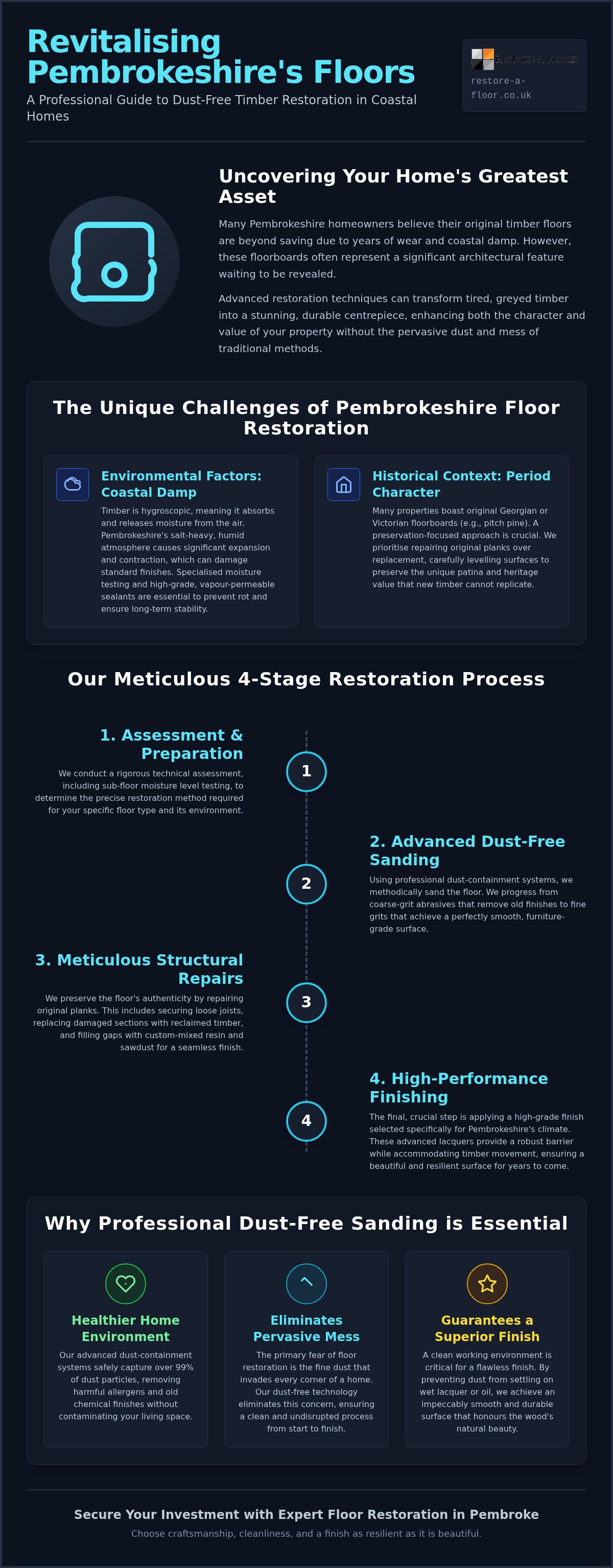
Could that worn, greyed timber beneath your feet actually be the most valuable architectural feature in your home? Many homeowners in Pembrokeshire assume that decades of heavy foot traffic and the persistent coastal damp have rendered their original floorboards unsalvageable, yet the reality is often quite the opposite.

We understand that the prospect of floor restoration Pembroke projects frequently brings a sense of trepidation, particularly regarding the fear of pervasive dust invading every corner of your living space or uncertainty about whether a floor is truly worth saving. You'll discover how advanced, specialised dust-free techniques can revitalise even the most tired surfaces, transforming them into durable, high-end assets that honour your property's unique history. This article explores the technical precision required to combat local moisture challenges, details our meticulous restoration process, and provides the expert maintenance advice you need to ensure your floors remain a stunning centrepiece for years to come. By choosing a methodical approach that prioritises both cleanliness and craftsmanship, you can secure a finish that's as resilient as it is beautiful.

Table of Contents

The Unique Challenges of Floor Restoration in Pembroke and Coastal Pembrokeshire

Restoring a floor in West Wales involves far more than simple aesthetics. The geography of the region dictates the technical approach. Because Pembroke sits so close to the Atlantic, the environmental conditions are significantly more aggressive than those found in inland counties. Timber is a hygroscopic material, meaning it constantly breathes, absorbing and releasing moisture from the surrounding air. In our coastal environment, this leads to pronounced expansion and contraction cycles that can easily ruin a substandard finish.

The sea air changes everything. Whilst an inland project might follow a standard drying schedule, the saline-heavy atmosphere in Pembrokeshire can interact with the chemical composition of certain modern lacquers. Salt particles are naturally abrasive and moisture-attracting; if they're trapped beneath a finish, they can compromise the bond between the wood and the sealant. Successful floor restoration Pembroke projects require a deep understanding of these local variables, from the rugged Victorian pine boards in town centres to the polished concrete floors of contemporary coastal builds.

Environmental Factors: Dealing with Coastal Damp

Moisture management is the cornerstone of our process. Before any work begins in Haverfordwest or Pembroke, we conduct rigorous testing of the sub-floor moisture levels. Older properties often lack modern damp-proof membranes, meaning the timber relies on a delicate balance of airflow and evaporation. We select finishes that provide a robust barrier against liquid spills whilst remaining vapour-permeable to prevent rot. Pembrokeshire's unique maritime climate necessitates the use of high-grade sealants that accommodate significant thermal and hygroscopic movement without fracturing. This technical foresight ensures that the floor remains stable even during the dampest winter months.

Historical Context: Restoring Pembroke's Period Character

Pembroke is defined by its architectural heritage, housing a wealth of Georgian and Victorian townhouses that still retain their original floorboards. Identifying these timbers, often slow-grown pitch pine or Baltic deal, is the first step in a faithful restoration. We operate with a strict ethics of preservation, prioritising the repair of original planks over replacement whenever possible. Preserving the "patina" of a hundred-year-old floor adds significant heritage value and character to a home that modern timber simply cannot replicate.

During the floor sanding process, we use specialised techniques to level the surface without stripping away the historical soul of the wood. We carefully stabilise structural movement and fill gaps with resin-bound sawdust from the floor itself, ensuring a seamless and authentic appearance. This meticulous attention to detail transforms a neglected architectural element into a high-end asset that honours the building's long history.

Selecting the Correct Restoration Method for Your Surface

Choosing the appropriate restoration pathway requires a technical assessment of the existing substrate and its intended use. A Victorian pine floorboard demands a completely different set of protocols compared to a modern industrial concrete slab or a heritage marble hallway. Precision is mandatory. Successful floor restoration Pembroke homeowners choose depends on selecting a method that respects the material's integrity whilst enhancing its natural durability. We categorise our approach based on the specific requirements of the surface, ensuring the technical solution matches the architectural context.

Wood Floor Sanding and Refinishing Techniques

The wood floor sanding process is a methodical progression from destruction to refinement. We begin with coarse-grit abrasives to strip away decades of failed sealants and surface damage, before transitioning through medium and fine grits to achieve a furniture-grade smoothness. For heritage boards, we often perform structural repairs, such as replacing damaged sections with reclaimed timber or securing loose joists to eliminate movement. Our experience with wood floor sanding Swansea projects has refined our ability to handle diverse timber species found across West Wales.

The choice of finish is equally critical. Lacquers provide a hard-wearing, high-traffic barrier that's ideal for busy kitchens, whereas oils and waxes penetrate deep into the grain to offer a more traditional, matte aesthetic. Safety is a priority during this phase. Utilising professional extraction systems effectively mitigates the dangers of sanding dust, protecting both the technician and the household environment from airborne particulates. This clean, controlled approach allows for a superior bond between the wood and the chosen finish.

Polished Concrete and Stone Care

Concrete is no longer relegated to the garage. We utilise heavy-duty diamond grinding to transform dull, industrial surfaces into high-end residential features. This concrete floor grinding and polishing process involves progressively finer diamond pads to close the pores of the concrete, resulting in a naturally reflective surface that requires no topical coatings. For natural stone such as marble or limestone, deep cleaning is merely the first step. We follow this with honing and sealing to restore the stone's clarity and protect it against staining.

Tiled floor restoration, particularly for Victorian quarry tiles, involves removing deep-seated grime and old waxes that have clouded the surface. We apply breathable, impregnating sealers that allow moisture to escape from the sub-floor whilst preventing new stains from taking hold. If you aren't sure which method suits your property, a professional survey can identify the most resilient path for your specific flooring. You might find that requesting a technical assessment is the most efficient way to determine the best restoration strategy for your home.

Case Study: Revitalising a Victorian Townhouse Floor in Pembroke

A Grade II listed townhouse in the shadow of Pembroke Castle provided the setting for one of our most demanding projects. The client had recently uncovered original pine floorboards that had been concealed beneath layers of synthetic carpet and bitumen adhesive for over half a century. Years of neglect had left the timber heavily stained, with significant structural movement caused by the settling of the building over its 150-year history. This project epitomised the complexities of floor restoration Pembroke homeowners encounter when attempting to preserve period character whilst meeting modern standards of durability.

The primary challenge lay in the sheer volume of contaminants. Bitumen adhesive is notoriously difficult to remove without scorching the wood, and the structural gaps between the boards were wide enough to allow significant heat loss from the sub-floor. We needed a solution that was technically rigorous yet sympathetic to the building's heritage status.

The Restoration Process Step-by-Step

Our approach followed a methodical progression to ensure the structural integrity of the floor matched its eventual aesthetic finish. We prioritised precision at every stage:

  • Step 1: Initial assessment and board stabilisation. We secured loose boards and reinforced the underlying joists to eliminate the squeaks and movement that had developed over ten decades.

  • Step 2: Professional dust-free sanding. Utilising HEPA-filtered extraction equipment, we removed the bitumen and grime without allowing particulates to escape into the rest of the home.

  • Step 3: Gap filling and sympathetic repairs. We used a resin-bound mix of fine sanding dust and slivers of reclaimed Victorian timber to fill voids, creating a seamless, draught-proof surface.

  • Step 4: Application of high-traffic protective finishes. Three coats of a high-performance, matte lacquer were applied to provide a robust moisture barrier that highlights the natural grain.

Client Outcome and Long-Term Performance

The transformation was absolute. By removing the accumulated grime of a century, we revealed the honey-toned warmth of the original slow-grown pine, turning a neglected room into a high-end living space. This restoration didn't just improve the visual appeal of the home; it significantly enhanced the property’s market value by securing a key historical asset. Maintenance is now a simple matter of dry sweeping and occasional damp mopping, as the professional-grade seal prevents liquid ingress and staining. The homeowner noted that the dust-free environment maintained throughout the project was a deciding factor in their overall satisfaction.

Floor restoration Pembroke

Why Professional Dust-Free Sanding is Essential for Pembrokeshire Homes

Many homeowners delay essential floor restoration Pembroke projects because they dread the inevitable "dust storm" that settles into soft furnishings and kitchen cupboards for months. This apprehension is often rooted in experiences with outdated DIY methods or the use of budget equipment that lacks integrated extraction. Modern technology has fundamentally dismantled this myth. Professional dust-free systems allow us to work in sensitive residential environments without the need to seal every doorway, empty every cupboard, or vacate the premises for an extended period.

Beyond mere convenience, the health and safety implications are significant. Older Pembrokeshire properties often harbour lead-based pigments or toxic historic varnishes within their floor layers. Traditional sanding releases these as fine, inhalable particulates that can linger in the air. Our specialised HEPA-filtered equipment captures these hazards at the source. This is particularly vital for households managing respiratory conditions or those with young children. This level of control also increases project efficiency. We spend far less time on site preparation and post-project cleaning, which translates to a faster turnaround for the homeowner.

The Mechanics of Dust-Free Technology

Our systems utilise high-powered vacuum units connected directly to the sanding head, capturing 99.8% of airborne particles before they can leave the machine. This is not just about domestic cleanliness; it directly impacts the final finish quality. Even a microscopic layer of dust can settle into a wet lacquer or oil, causing a gritty texture and compromising the chemical bond. Whether we are conducting residential work or large-scale commercial wood floor sanding Birmingham projects, the technical requirement for a pristine, particulate-free environment remains identical to ensure a high-end result.

Professional Standards vs. DIY Restoration

Hiring 'budget' equipment or attempting a DIY restoration often results in uneven surfaces, deep scratches, and circular swirl marks that only become visible once the finish is applied. Professional-grade abrasives and heavy-duty planetary sanders ensure a perfectly flat, furniture-grade surface that is impossible to achieve with hire-shop machinery. This technical rigour is the same standard we apply to high-performance gym floor sanding and sealing, where surface evenness is critical for safety and performance. If you value a clean, efficient, and technically superior result, contact our team for a professional dust-free assessment of your flooring today.

Securing Your Investment with Restore-A-Floor in Pembroke

Choosing a partner for floor restoration Pembroke homeowners can trust involves looking beyond the price tag to the quality of the craftsmanship. Restore-A-Floor represents over 20 years of dedicated industry experience. As a family-owned property specialist, we've spent decades refining a methodology that balances technical proficiency with a commitment to local heritage. Our work across Pembrokeshire and Haverfordwest isn't merely about surface-level aesthetics; it's about the long-term protection of your home's structural assets through professional-grade intervention.

We follow a rigorous progression from the initial technical survey to the final, post-finishing inspection. This journey begins with a detailed assessment where we evaluate timber species, moisture levels, and sub-floor stability to ensure the restoration is built on a solid foundation. For commercial entities in Pembroke Dock, we manage large-scale projects with the same meticulous attention to detail we apply to residential hallways. Because we value professional standards and long-term satisfaction, our policy is to take payment only upon completion of the work, ensuring you are entirely satisfied with the outcome.

Local Pembrokeshire Expertise

Our deep roots in the community provide us with a unique perspective on the architectural styles prevalent in Tenby and Pembroke. We understand the specific requirements of coastal properties, from the salt-air challenges of seafront terraces to the structural nuances of inland farmhouses. We support local businesses and homeowners by providing durable flooring solutions that withstand the test of time. This technical rigour extends beyond residential wood; our expertise in sports hall floor line marking demonstrates our capacity for precision and compliance in high-traffic, professional environments where durability is non-negotiable.

Next Steps: Requesting Your Bespoke Quote

Organising a site visit and bespoke flooring assessment is a straightforward process designed to provide clarity and security. During your free flooring consultation, we discuss your lifestyle, the anticipated foot traffic, and the specific aesthetic you wish to achieve. We don't believe in one-size-fits-all solutions. Instead, we tailor our sealants and finishes to your specific requirements, ensuring the final result is as practical as it is beautiful. Our technicians guide you through the technical journey, explaining every choice from grit selection to the final protective coat. If you are ready to revitalise your home, contact the Restore-A-Floor team for your Pembroke project to begin your restoration journey today.

Elevate Your Home with Professional Floor Restoration

Professional restoration is a strategic investment in the longevity and character of your home. By understanding the unique coastal challenges of West Wales and utilising advanced dust-free technology, you can achieve a high-end finish without the traditional disruption of airborne particulates. Whether you are uncovering original Victorian pine or polishing modern concrete, the technical precision offered by seasoned experts ensures a result that's both durable and aesthetically striking.

Our team brings over 20 years of bespoke flooring experience to every project, operating as fully qualified and insured local specialists dedicated to the highest professional standards. We prioritise your comfort and the building's integrity, delivering a clean, efficient service that honours the architectural history of the region. If you are ready to begin your floor restoration Pembroke project, our team provides the technical guidance required for a flawless finish.

Ready to see the potential in your surfaces? Request your free floor restoration quote in Pembroke today and let us guide you through the process of revitalising your property. Your floors are the foundation of your home's character; give them the expert care they deserve.

Frequently Asked Questions

How long does professional floor restoration in Pembroke typically take?

A standard residential project typically spans two to four working days, though the exact duration depends on the room size and the number of coats required. We account for the specific drying times of professional lacquers and oils, which can be affected by local humidity levels. Larger commercial projects or those requiring extensive structural repairs may extend this timeline. We provide a precise schedule during our initial site visit to ensure minimal disruption to your household.

Is dust-free sanding really 100% dust-free for Pembrokeshire homes?

Our specialised equipment is 99.8% effective at capturing particulates at the point of contact, which is a significant advancement over traditional methods. Whilst no system can claim absolute perfection, our HEPA-filtered extraction ensures that the dust storm associated with older machinery is entirely avoided. This allows for a clean environment during floor restoration Pembroke projects, protecting your soft furnishings and air quality. You won't need to vacate your home or seal every internal door.

Can you restore Victorian floorboards that have been covered by carpet for decades?

Most Victorian floorboards are salvageable even after decades of concealment beneath carpets or synthetic coverings. We specialise in removing stubborn bitumen adhesives and repairing structural damage caused by historic plumbing or electrical work. By sourcing reclaimed timber that matches the age and grain of your original boards, we can create a seamless finish. We assess the thickness and integrity of the timber during our free consultation to confirm its suitability for the sanding process.

What is the best finish for a high-traffic hallway in a Pembroke property?

For high-traffic areas like hallways, we recommend a professional-grade, multi-coat lacquer finish. These modern sealants provide a hard-wearing barrier that resists scratches, scuffs, and moisture ingress more effectively than traditional waxes. In Pembrokeshire homes, where coastal grit can be tracked indoors, a high-durability finish is essential for long-term protection. We offer various sheen levels, from ultra-matte to gloss, allowing you to maintain the aesthetic character of your property without sacrificing resilience.

Do I need to move all my furniture out before the floor restoration begins?

All furniture must be removed from the target area before our technicians arrive to ensure a continuous and even finish. A completely clear floor allows our heavy-duty machinery to glide across the surface without interruption, preventing lap marks or uneven sanding. If you have particularly heavy items, we recommend organising their removal in advance. This preparation is a critical step in our methodology, ensuring we can focus entirely on the precision of the restoration work itself.

How much does floor restoration in Pembrokeshire cost compared to new flooring?

Restoring an original floor is almost always a more cost-effective investment than installing a new, high-quality timber equivalent. Beyond the immediate financial saving, professional restoration preserves the architectural heritage and patina of your property, which significantly enhances its market value. New flooring often requires expensive sub-floor preparation that restoration avoids. We provide bespoke quotations based on your specific floor condition, ensuring you receive a transparent breakdown of the technical requirements for your project.

Can you restore concrete floors in modern Pembroke apartments?

We certainly provide concrete floor polishing for modern apartments and commercial spaces throughout the region. Our process involves diamond-tipped grinding heads that remove surface imperfections and reveal the natural aggregate beneath. This results in a sleek, industrial-chic aesthetic that's incredibly durable and easy to maintain. Unlike topical coatings that can peel, a polished concrete surface is a permanent structural refinement that's perfectly suited to contemporary Pembrokeshire interiors and high-traffic residential environments.

How often should I have my restored floors professionally maintained?

We recommend a professional maintenance assessment every three to five years for high-traffic residential floors. Whilst daily care involves simple sweeping and damp mopping with neutral cleaners, a periodic screen and recoat can refresh the protective layer before it wears down to the bare wood. This proactive approach prevents the need for a full sand-back in the future. Regular maintenance schedules are tailored to your specific household foot traffic and the type of finish originally applied during the restoration.


bottom of page