

Reclaimed Wood Flooring Installation in Cardiff: A Practical 2026 Guide
A reclaimed floor can look full of character and still be wrong for a room if its boards aren’t suitable for the conditions beneath them. Successful Reclaimed wood flooring installation Cardiff depends on assessing the timber, the subfloor and the finished floor as one plan, not simply choosing boards for their appearance.
It’s understandable to wonder whether irregular boards will sit securely, create an even surface and suit your property. Careful assessment and preparation help turn their natural variation into a cohesive finish. Restore-A-Floor provides tailored wood-floor installation in Cardiff, from preparation through to the final finish, drawing on over 20 years of industry experience.
This practical guide explains how to judge reclaimed boards for a room, prepare the subfloor, plan the layout and approach fitting and finishing. You’ll also find the details to consider when planning a project and requesting a tailored quotation.
Table of Contents
Reclaimed wood flooring in Cardiff: what makes it different?
Assessing reclaimed floorboards: condition, stability and suitability
Reclaimed wood flooring versus new timber: choosing the right fit
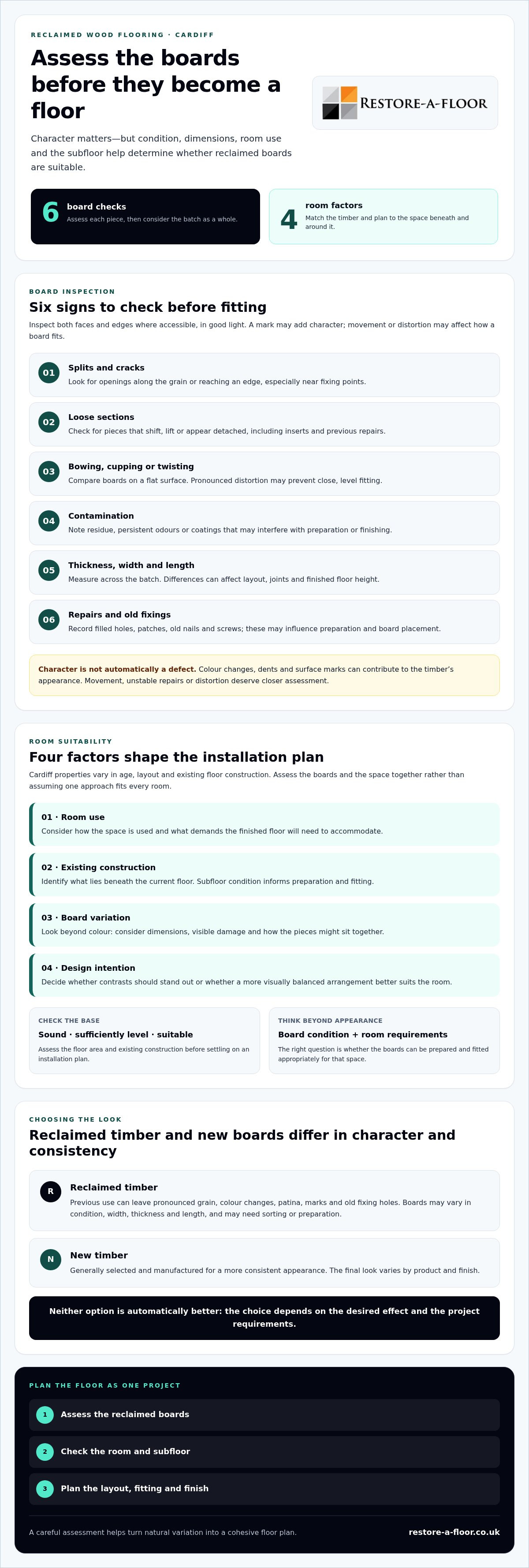
Reclaimed wood flooring installation in Cardiff: the project stages
Plan your Cardiff reclaimed wood flooring installation with Restore-A-Floor
Reclaimed wood flooring in Cardiff: what makes it different?
Reclaimed wood flooring is made from timber that has been used before and recovered for reuse. It differs from new boards given a distressed appearance: marks and variation in reclaimed timber come from its previous life, rather than being added to imitate age. Reclaimed lumber can come from a range of sources and be put to uses including flooring, but the word “reclaimed” alone doesn’t tell you the condition or specification of a particular board.
Its appeal lies in details that are hard to make identical: pronounced grain, changes in colour and patina, and signs of previous use. These features can bring depth and individuality to a room. They also mean boards may differ in condition, width, thickness and length. A floor’s suitability depends on more than its appearance, so assess the timber and the room before fitting.
How reclaimed timber differs from new wood flooring
Age, former use and any processing can all influence how reclaimed boards look. One may have a smooth, weathered surface; another may show old fixing holes, marks or a different grain pattern. New timber is generally selected and manufactured for a more consistent appearance, although the final look varies by product and finish. Neither option is automatically better: the right choice depends on the effect you want and the project requirements.
“Reclaimed” describes the timber’s history, not a guaranteed grade, finish or set of dimensions. Boards may need sorting or preparation to work within a considered layout. The individual pieces matter, but so does how their differences will look across the complete floor.
Is reclaimed flooring suitable for a Cardiff property?
It can be suitable, provided the boards and installation plan are matched to the room. Cardiff properties vary in age, layout and existing floor construction, so there isn’t one assumed subfloor or fitting approach. The room’s intended use, the condition and type of the underlying floor, and the reclaimed boards’ characteristics all inform the decision.
Consider the appearance you’re aiming for alongside practical requirements. A strongly varied mix may be central to the design, whilst a more controlled arrangement could better suit the room’s overall scheme. The key question is whether the selected boards can be prepared and fitted appropriately for that space, not simply whether their surface looks appealing.
Before planning Reclaimed wood flooring installation Cardiff, consider these points together:
Room use: Think about how the space is used and the demands the finished floor will need to accommodate.
Existing construction: Identify what lies beneath the current floor, since preparation and fitting depend on the subfloor.
Board variation: Look beyond colour to assess dimensions, visible damage and how pieces might sit together.
Design intention: Decide whether you want the timber’s contrasts to stand out or a more visually balanced arrangement.
These considerations help turn distinctive timber into a coherent floor plan. A careful assessment can show whether the boards suit the property and what preparation may be needed before installation begins.
Assessing reclaimed floorboards: condition, stability and suitability
A useful assessment looks beyond the most attractive boards. Before planning Reclaimed wood flooring installation Cardiff, consider whether each piece is sound enough to prepare and fit, then whether the collection as a whole can form a stable, even floor. A mark may add character; a split or pronounced twist may affect how a board sits or joins its neighbours.
Which signs of wear matter before installation?
Inspect boards individually in good light, checking both faces and edges where accessible. Note the type and position of any damage rather than judging from appearance alone. A dark stain or old nail hole may be mainly visual, whilst a loose section, deep split or severe distortion deserves closer assessment.
Splits and cracks: Look for openings that run along the grain or reach an edge, especially near fixing points.
Loose sections: Check for pieces that shift, lift or appear detached, including any inserts or previous repairs.
Distortion: Compare boards on a flat surface for pronounced bowing, cupping or twisting that could prevent close, level fitting.
Contamination: Look for residue, persistent odours or coatings that may interfere with preparation or finishing.
Dimensions: Measure thickness, width and length across the batch. Differences can affect the layout, joints and finished floor height.
Repairs and fixings: Record filled holes, patches, old nails or screws, as these may influence preparation and where a board can be used.
Visible wear isn’t automatically a defect. Colour changes, dents and surface marks can contribute to the timber’s character, while movement, unstable repairs or distortion may affect the floor’s surface and fit. Photographs can help document what you’ve noticed, but they can’t establish the full condition of a board or how it will perform once prepared. Some pieces may need different treatment or may not suit the intended area.
How the property and subfloor affect the decision
Board checks are only part of the picture. Assess the floor area and the property’s existing construction to understand whether the base is sound, sufficiently level and suitable for the proposed installation. Subfloor condition and moisture readings inform the preparation plan; the method and interpretation should suit the floor and site, rather than rely on a generic assumption.
Compare the reclaimed boards’ thickness with the available floor height. Changes can affect thresholds, door clearances and transitions to adjoining surfaces, so include these details in the plan before fitting begins. The National Wood Flooring Association installation guidelines offer further technical context on wood-floor installation, including subfloor preparation and moisture management.
Reclaimed boards should be assessed individually and in context: their condition, dimensions and relationship to the subfloor all shape a suitable installation plan. For a project-specific assessment and tailored wood-floor preparation in Cardiff, discuss your flooring project with Restore-A-Floor.
Reclaimed wood flooring versus new timber: choosing the right fit
Neither reclaimed nor new timber is automatically the better choice. The right fit depends on the appearance you want, the boards available and the practical demands of the room. Reclaimed wood brings variation shaped by previous use, whilst new boards are often selected for a more consistent look and specification. That difference can guide your decision, but both options need suitable preparation and careful installation.
When reclaimed timber may suit the project
Reclaimed boards may suit an interior where visible history and a less uniform surface are part of the intended design. They can bring variation to a room with simple furnishings, or complement existing features whose materials and character matter to the scheme. The decision still depends on the particular boards: their dimensions, condition and available quantity need to work with the room and planned layout.
Variation is easier to manage when boards and layout are planned together. Sorting pieces and considering how their tones and lengths sit alongside one another can help create a deliberate composition, rather than leaving the finished floor to chance. Reclaimed timber isn’t inherently less expensive or better-performing than new flooring, and choosing it alone doesn’t establish a universal environmental benefit. Its history and sourcing are part of the project’s context, not a substitute for assessing suitability.
When new timber may be the more practical choice
New timber may be a stronger fit if you’re aiming for a more consistent appearance, need a particular board specification, or want fewer variations to accommodate during layout. This can make planning more predictable, especially where the design relies on regular dimensions or a restrained, uniform finish. These are practical preferences, not a judgement about which material is superior.
Both choices require the floor area and subfloor to be considered, with preparation and fitting planned for the selected boards. For Reclaimed wood flooring installation Cardiff, weigh the look you want against the condition and dimensions of the timber, the room’s requirements and the level of variation you’re comfortable incorporating. That framework helps prioritise the project’s needs over a trend and sets a clearer direction for the installation plan.
Reclaimed wood flooring installation in Cardiff: the project stages
A successful installation follows a sequence, with each decision guided by the boards, the room and the existing floor beneath them. For Reclaimed wood flooring installation Cardiff, planning the stages in advance helps coordinate preparation, layout and finishing, while allowing the approach to respond to what an on-site assessment reveals.
Initial discussion: Set out the room’s intended use, the appearance you want and details of the reclaimed boards available.
Site assessment: Review the room, floor construction, subfloor condition and relevant height transitions. Compare these findings with the boards’ dimensions and condition.
Preparation: Clear the work area and prepare the subfloor as required. Agree how any necessary removal, repairs or other planned work will be coordinated.
Board layout: Sort and arrange boards with their variation, lengths and the room’s shape in mind. Plan the visual balance before fitting begins.
Fitting: Install the boards using an approach suited to the project and the assessed floor conditions.
Finishing: Select and apply a finish that complements the timber and intended appearance, then review the completed floor and care guidance.
Preparing the room and floor before fitting
Good preparation starts with practical access. Remove furniture and loose items from the room, and plan how boards and equipment will reach the work area. If decorating or other building work is also scheduled, coordinate its order with the flooring stages so the prepared floor isn’t exposed to avoidable damage. Assess the subfloor for its condition and level, then prepare it to suit the installation rather than covering it without review.
Layout deserves equal care. Placing boards before fitting allows the installer to distribute differences in tone, grain and length across the room, rather than clustering similar pieces together by chance. The arrangement can also respond to room proportions and edges, helping the natural variation feel intentional.
Before work starts, use this short preparation checklist:
Clear furniture and personal items from the room and access route.
Discuss the location and quantity of reclaimed boards available for the project.
Coordinate flooring with decorating or other planned work.
Agree how access, dust management and protection of nearby areas will be handled.
Fitting, finishing and reviewing the completed floor
Once the subfloor and layout are ready, boards are fitted according to the project plan. Sanding or cutting can create dust, so appropriate management is important. Restore-A-Floor maintains a dust-free environment for its flooring work, including specialist dust-free refinishing for wood floors. Choose the finish with the reclaimed timber’s condition, surface and desired appearance in mind, as well as the room’s requirements.
At completion, review the floor with the installation team. Discuss how the boards look as a whole, raise any points that need attention and go through the care guidance for the chosen finish. Restore-A-Floor supports wood-floor projects from preparation through to the final finish, drawing on over 20 years of industry experience. Request a tailored flooring quotation to discuss your Cardiff project.
Plan your Cardiff reclaimed wood flooring installation with Restore-A-Floor
A considered project brings four factors together: the condition of the reclaimed boards, the requirements of the property, the appearance you want and a fitting plan that accounts for both. Addressing them as a whole helps clarify what preparation the floor needs and how its distinctive character can carry through the finished room.
Restore-A-Floor provides bespoke wood-floor installation and project support from preparation to final finish in Cardiff. With over 20 years’ industry experience and a qualified team, the company can shape an installation approach around your property and project requirements. Its local flooring work also serves Swansea, Bristol, Pembrokeshire, Haverfordwest and Cardiganshire.
What to include in a flooring project enquiry
A few practical details give the project discussion a useful starting point. Share the Cardiff property location, how the room is used and its approximate floor area. Describe the look you’re aiming for, such as a more varied, characterful surface or a visually balanced layout, and note any known concerns about the existing floor or subfloor. Include what you know about the reclaimed boards, too.
These details provide context for an assessment and tailored quotation. If you’re unsure about a technical point, simply describe what you’ve observed; the project plan can take shape around the information available and the requirements of the space.
Property: Cardiff location and room type.
Room: Approximate floor area and intended use.
Boards: Any known dimensions, quantity or condition details.
Finish: Your preferred appearance and the character you’d like to retain.
Existing floor: Known subfloor details, level changes or other concerns.
Discuss your reclaimed flooring project
The installation approach is tailored to the property, boards and desired finish, rather than treating every reclaimed floor as the same job. This matters especially if you’re considering a parquet layout, where the pattern and board characteristics need to work together. Preparation and finishing are part of the overall plan, connecting the practical requirements of fitting with the appearance you want to achieve.
If your plans also include work on an existing floor, you can discuss how that fits into the wider project, including wood floor sanding and refinishing in Swansea where relevant. For reclaimed parquet, a bespoke parquet floor installation guide can help you consider how pattern, room proportions and timber character relate. Keep the focus on your Cardiff property and the work required there.
With the room details and your preferred look in hand, the next step is to discuss the project and request a quotation tailored to its scope. Request a free flooring quotation from Restore-A-Floor to start planning your Cardiff reclaimed wood floor.
Bring your reclaimed flooring plans into focus
The right reclaimed floor should feel at home in your property, not simply look striking on its own. A thoughtful project starts by matching the timber’s character with how you want the room to look and function, then shaping the work around that vision. For Reclaimed wood flooring installation Cardiff, Restore-A-Floor can help turn those preferences into a tailored flooring plan.
With over 20 years of industry experience, a qualified flooring team and experience across residential and commercial projects, Restore-A-Floor brings practical knowledge to planning and preparing your floor. Share your room details, the boards you have in mind and the finish you’re hoping to achieve to start a focused conversation about your project.
Request a free quotation for your Cardiff flooring project and take the next step towards a floor that reflects your property and taste.
Frequently Asked Questions
Is reclaimed wood flooring suitable for older homes in Cardiff?
Yes, reclaimed flooring can suit an older Cardiff home if the boards and existing floor construction are appropriate for the room. A property’s age alone doesn’t determine suitability: past alterations, repairs and changes between adjoining rooms can all affect the installation plan. Consider practical details such as door clearances and transitions to other flooring. An assessment of the property helps establish what preparation is needed before the design is finalised.
How do you know whether reclaimed floorboards are suitable for installation?
Suitability is judged by combining a close inspection with measurements and a review of how the boards will work in the room. Keep boards from the same batch together, note differences in thickness and length, and consider whether their joints and edges can form a coherent layout. A few attractive pieces don’t establish that the whole batch is suitable. A practical assessment can identify which boards may be usable and which need further consideration.
Can reclaimed wood flooring be installed over an existing floor?
Sometimes, but it depends on the existing floor’s construction, condition and height, so covering it isn’t automatically appropriate. An extra layer can affect door clearance and transitions, whilst an unstable or uneven base may compromise the planned finish. Assess the current surface to establish whether it can provide a suitable base. In some projects, removing existing flooring and preparing what lies beneath may be more appropriate.
How long does reclaimed wood flooring installation take?
There isn’t one reliable duration for every project. The room’s area, the condition of the subfloor, the amount of board preparation and the complexity of the layout all influence the sequence of work. Finishing can also affect when the room is ready for normal use, depending on the finish selected. Once the project has been assessed, the installation team can outline the expected stages and explain how preparation and finishing fit into the schedule.
How much does reclaimed wood flooring installation in Cardiff cost?
Reclaimed wood flooring installation Cardiff projects are quoted individually, as the scope depends on factors such as room size, board condition, subfloor preparation, layout and finishing. A useful quotation request includes the property location, approximate floor area, room use and details of the timber you have. Restore-A-Floor offers free online quotation requests for projects in Cardiff, Swansea, Bristol, Pembrokeshire, Haverfordwest and Cardiganshire. Share the project details to request a quotation tailored to its requirements.
Is reclaimed wood flooring more sustainable than new timber flooring?
Reusing timber can give previously used boards another purpose, but that alone doesn’t prove a lower overall environmental impact than new flooring. The comparison depends on factors such as where the timber came from, how it was processed and transported, and what preparation is needed. If sustainability is important to your decision, consider the boards’ provenance and the work required to make them suitable. Avoid assuming that reclaimed material is always the better option.
How should reclaimed wood flooring be cleaned and maintained?
Follow care advice suited to the floor’s chosen finish, as products and cleaning methods can differ. As a general approach, remove loose grit regularly with a soft brush or suitable vacuum attachment, wipe spills promptly and avoid leaving standing water on the surface. Use protective pads beneath furniture to help limit scratches. Before applying a cleaning product or treatment, check that it’s appropriate for the finish, particularly if the floor has been recently completed.
Comments