

Ceramic Tile Cleaning and Restoration: The Definitive Architectural Guide
Every routine pass of a standard mop does not clean your floor; it simply drives a slurry of dirty wash water deeper into recessed, porous grout channels. Over time, that constant capillary siphoning leaves behind blackened joints and dulled surfaces, tempting many property owners to reach for harsh supermarket descalers that risk chemical bleaching and glaze damage. When those domestic fixes inevitably fail, facing the upheaval and expense of ripping out an entire floor feels thoroughly overwhelming. Fortunately, specialist ceramic tile cleaning and restoration offers an architectural-grade solution that eliminates the need for full replacement.
You don't need to endure costly demolition to reclaim clean, vibrant tiles and pristine, stain-resistant grout. In this definitive guide, you will discover how professional mechanical extraction, targeted grout renewal, and advanced protective treatments rejuvenate tired ceramic surfaces whilst establishing a durable hydrophobic barrier against future grease and moisture ingress. We walk you through the diagnostic sequence and technical processes required to revive original floor aesthetics and safeguard your investment for years to come.
Table of Contents
Understanding Ceramic Tile Anatomy and Why Routine Mopping Fails
Key Signs Your Ceramic Tiled Floor Requires Professional Restoration
Professional Ceramic Tile Restoration vs Replacement and DIY Cleaning
The Step-by-Step Methodology for Restoring Ceramic Tiles and Grout
Long-Term Preservation and Specialist Ceramic Care Across South Wales and the West
Understanding Ceramic Tile Anatomy and Why Routine Mopping Fails
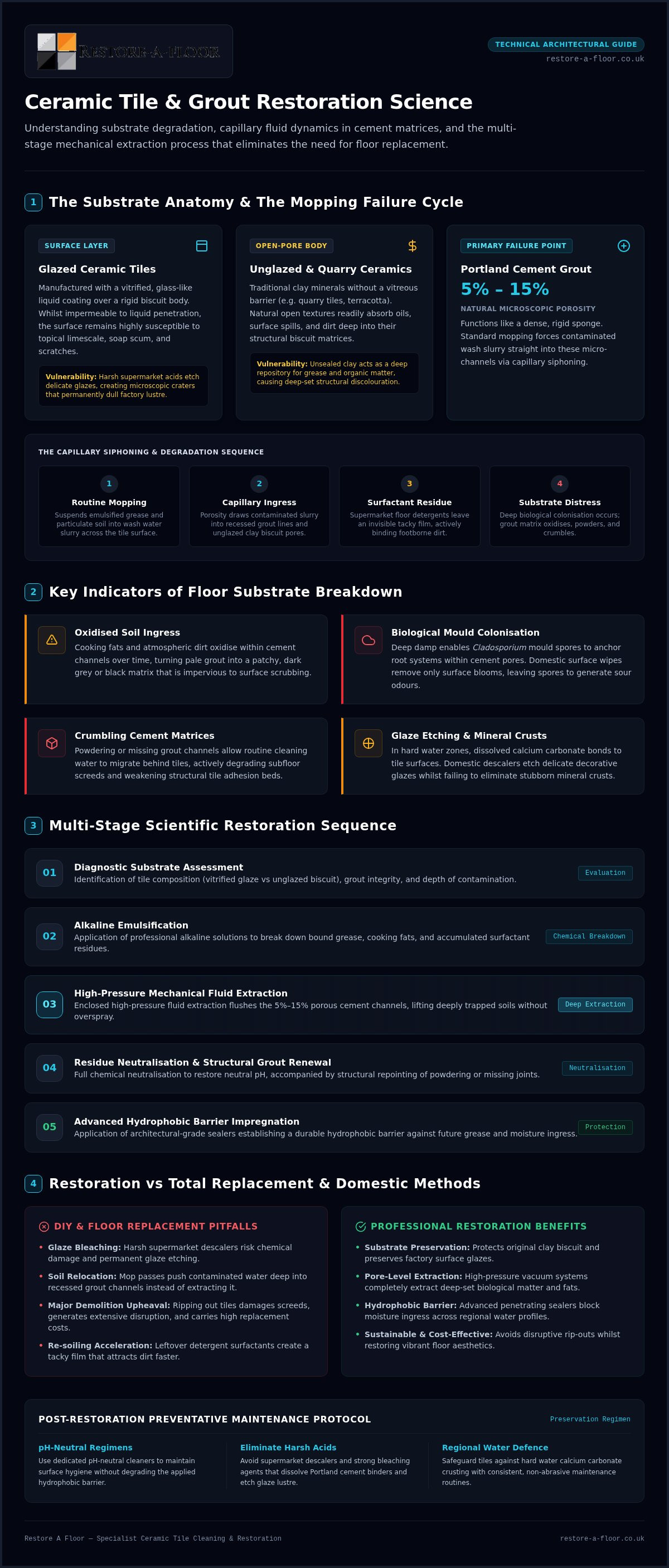
At an architectural level, ceramic floor tiles consist of natural clay minerals fired at high temperatures to create a rigid biscuit body. While this manufacturing process delivers exceptional structural durability, routine domestic maintenance often triggers rapid surface degradation. Standard string mopping fails because it simply suspends emulsified grease and fine particulate soil in wash water. Instead of lifting dirt away, mopping spreads a contaminated slurry across the floor, where it gravitates towards the lowest recesses. Over time, repeated applications of supermarket floor detergents compound the problem. Residual cleaning surfactants leave an invisible, tacky film behind that chemically attracts and binds dry atmospheric dust and footwear grime to the floor.
Glazed vs Unglazed Ceramic Tiles: Surface Chemistry and Vulnerabilities
The chemical profile of your tile surface determines how it interacts with daily spills and chemical cleaners:
Glazed Ceramics: Finished with a vitrified, glass-like liquid coating, these tiles resist liquid penetration. However, their glossy surface remains susceptible to topical limescale, soap scum, and scratches from abrasive particles dragged across the floor.
Unglazed Ceramics: Open-textured surfaces, such as quarry tiles and traditional terracotta biscuits, lack a protective glass barrier. They readily absorb oily spills, liquids, and grime deep into their clay matrices.
Chemical Vulnerability: Applying harsh, supermarket acidic cleaners to shift grime often backfires. Strong acids etch delicate decorative glazes, permanently dulling the factory lustre and creating microscopic craters that trap dirt faster.
The Grout Dilemma: How Micro-Porous Cement Lines Trap Dirty Water
The primary point of failure in any tiled floor is rarely the tile itself; it is the cementitious grout joint. Standard Portland cement grout possesses a natural microscopic porosity of 5% to 15%, causing it to act like a dense, rigid sponge. When wet mopping passes across the floor plane, capillary draw siphons the suspended wash slurry into these microscopic channels.
Once deep inside the cement matrix, trapped moisture and organic matter provide an ideal breeding ground for black mould spores, bacterial colonies, and sour odours. Scrubbing with household brushes cannot dislodge these deeply embedded contaminants. Resolving this capillary saturation requires professional ceramic tile cleaning and restoration, combining alkaline emulsification with high-pressure fluid extraction to flush the pores clean without compromising the tile installation.
Key Signs Your Ceramic Tiled Floor Requires Professional Restoration
Domestic cleaners and stiff scrubbing brushes eventually reach their physical limits. When standard maintenance no longer lifts entrenched soils, ceramic flooring displays distinct physical and sensory indicators that signal deep substrate distress. Recognising these early warnings prevents irreversible structural decay, allowing property owners to address root causes before whole tiles crack or lift under daily traffic.
Severe Grout Discolouration, Mould Infiltration, and Structural Breakdown
Grout lines reveal the health of your tiled floor before the tiles themselves show wear:
Oxidised Soil Ingress: Cooking fats, footborne dirt, and detergent residues oxidise over time, locking into cement channels and turning pale grout an uneven, patchy dark grey or black that resists standard surface bleaching.
Persistent Biological Growth: Deep-seated damp encourages mould spores such as Cladosporium to root within porous cement. Surface wipes only remove top blooms, leaving the root system intact to produce lingering sour odours.
Crumbling Matrices: Powdering or missing grout sections allow daily wash water to migrate behind the tiles, degrading subfloor screeds and weakening adhesion beds.
Glaze Wear, Etching, and Stubborn Limescale in High-Moisture Zones
Dissolved minerals in domestic water supplies react chemically with tile surfaces. In hard water areas, calcium carbonate binds tenaciously to glazed ceramics, creating chalky white crusts that standard descalers struggle to dissolve safely without dulling adjacent surfaces. Similarly, gritty foot traffic causes fine micro-abrasions that wear away the original factory sheen. If an older topical acrylic wax was applied in the past, it eventually oxidises into a cloudy, scuffed, yellowed layer that traps particulate soil beneath it.
Powdery white deposits spreading along grout edges indicate efflorescence, where moisture drawn upward through the subfloor deposits mineral salts as it evaporates. When these mineral encrustations take hold, professional tiled floor restoration and cleaning provides the targeted, pH-balanced treatments needed to dissolve mineral hazes without compromising delicate glaze chemistries.
Subfloor Movement and Loose Tile Failures
Tapping lightly across a floor surface often yields an acoustic warning. A hollow, drum-like echo beneath footstep impact indicates adhesive voids or debonding between the ceramic biscuit and substrate, a direct violation of installation integrity specified under BS 5385-3:2024. Subfloor deflection across joists or thermal expansion can fracture rigid grout lines, particularly around room perimeters. Addressing these faults promptly through specialised ceramic tile cleaning and restoration arrests subfloor movement, restabilising loose units before severe fractures force an expensive, unwanted floor replacement.
Professional Ceramic Tile Restoration vs Replacement and DIY Cleaning
When confronted with heavily soiled ceramic floors, property owners often assume demolition is the only path to a clean finish. Complete tile replacement brings substantial architectural disruption, structural risks, and heavy environmental waste. In contrast, restorative conservation retains sound clay biscuits whilst renewing vulnerable grout channels. Opting for professional ceramic tile cleaning and restoration eliminates the need for pneumatic breakers, skip hire, and messy substrate re-levelling, preserving original finishes with minimal disruption to your home or commercial premises.
The Risks of Harsh Domestic Acids and Abrasive Cleaning Methods
Attempting to resolve stubborn grime with aggressive domestic measures frequently inflicts permanent substrate damage:
Chemical Etching: Supermarket descalers containing unbuffered hydrochloric acid rapidly eat away the calcium carbonate binder in cement grout, turning joints brittle and porous.
Mechanical Scouring: Wire pads and abrasive scouring blocks inflict micro-scratches across glazed ceramic wear layers, permanently ruining the factory finish.
Steam Injection Pitfalls: Domestic steam mops force superheated moisture deep into microscopic grout fissures. Over sustained periods, that trapped vapour destabilises flexible adhesives beneath the tile bed.
Environmental and Financial Advantages Over Complete Tile Replacement
Ripping up an existing floor generates hundreds of kilograms of inert masonry waste destined for landfill. Beyond disposal fees, demolition risks severing delicate underfloor heating elements, damaging bespoke skirting boards, and destroying adjacent wall plaster. Opting to restore rather than replace preserves the embodied carbon of the building fabric. Restorative intervention returns busy residential kitchens and high-footfall commercial spaces to active service within twenty-four to forty-eight hours, avoiding weeks of trades on site and catastrophic downtime.
Dust-Free, Low-Impact Machinery vs Household Floor Scrubbers
Manual arm scrubbing simply cannot generate the sustained energy needed to dislodge deeply bonded grime from recessed channels. Professional floor technicians deploy industrial contra-rotating cylindrical brushes (CRB) and orbital planetary systems. These low-moisture machines deliver consistent mechanical torque, working specialised nylon bristles deep into micro-porous grout joints without throwing slurry up against painted baseboards.
Coupled with enclosed high-pressure hydro-extraction hoods, these systems wash and capture suspended soils instantaneously under powerful continuous vacuum. No airborne dust or chemical mist escapes into adjacent living areas. The result is a uniformly purified tile surface and completely rejuvenated grout lines, achieving an architectural-grade finish that no household scrubber or mop can replicate.
The Step-by-Step Methodology for Restoring Ceramic Tiles and Grout
Architectural restoration relies on precise chemistry and mechanical discipline rather than aggressive surface scouring. Achieving lasting results demands a rigorous sequence: chemical breakdown, deep extraction, structural repointing, scientific moisture verification, and protective barrier application. Professional ceramic tile cleaning and restoration balances each stage carefully, ensuring the floor substrate is fully neutralised and completely dry before any sealing begins.
Deep Alkaline Emulsification and High-Pressure Rotary Agitation
The process starts with specialised alkaline emulsifiers dwelling across the floor surface to saponify aged fats, grease, and stubborn wax residues. Heavy-duty planetary machinery then works dense nylon bristles into recessed grout lines, breaking surface tension and dislodging compacted particulates. Enclosed pressure hoods immediately flush the suspended slurry into recovery tanks under continuous vacuum, neutralising the tile face back to a balanced pH 7.0 without soaking surrounding building fabric.
Precision Grout Repair, Re-Pointing, and Colour Sealing Treatments
Defective grout undermines the structural stability of the floor plane:
Dust-Free Raking: Powdering or fractured grout joints are excised using dust-extracted oscillating mechanical tools to protect delicate tile arrises.
Polymer Re-Pointing: Technicians float colour-matched, polymer-modified cement mortar seamlessly into cleared channels to re-establish joint integrity.
Membrane Colour Sealing: When cement matrices suffer permanent cosmetic staining, advanced topical colour sealers coat porous joints with an impervious resin barrier that locks out grease, moisture, and biological growth.
For detailed regional case insights and practical applications across heritage properties, read our comprehensive guide on tiled floor restoration Cardiff.
Protective Impregnating Sealers and Hydrophobic Barriers
Applying sealers over wet substrates traps moisture, causing cloudy efflorescence beneath the surface. Pinless electronic moisture meters confirm the floor has dried below safe threshold limits before protective application starts. Technicians then apply sub-surface fluoropolymer impregnators to unglazed clay biscuits and exposed cement lines.
These advanced impregnating sealers maintain full vapour permeability, allowing subfloor moisture to evaporate naturally whilst repelling top-down oil, wine, and water ingress. A final liquid droplet test confirms zero absorption across both tile and joint. If you are ready to revive your tired floors, schedule your tiled floor restoration and cleaning with Restore-A-Floor to secure long-term durability and craftsmanship.
Long-Term Preservation and Specialist Ceramic Care Across South Wales and the West
Securing a pristine finish is only half the battle; preserving it requires a disciplined aftercare strategy. Once professional restoration re-establishes structural integrity and applies hydrophobic barriers, routine maintenance dictates how long those treatments endure. Coarse grit tracked in from outside acts like sandpaper against tile glazes. Installing high-absorption barrier matting at primary entrances traps mineral soils and road salts before they cause micro-scratches or compromise protective seals.
PH-Neutral Maintenance Regimes to Protect Grout Barriers
Daily cleaning habits make or break your protective sealers:
Avoid Corrosive Cleaners: Never use supermarket washing-up liquids, neat bleach, or malt vinegar. These degrade fluoropolymer impregnators and dissolve protective colour seal membranes.
Use Dedicated pH-Neutral Solutions: Wash with neutral specialist floor cleaners that lift grime without leaving surfactant deposits behind.
Implement Clean Mop Rinsing: Clean flat microfibre mops frequently in fresh water to lift suspended soil rather than smearing dirty slurry back across grout joints.
Blot Acidic Spills Promptly: Red wine, citrus juice, and salad dressings should be dabbed immediately with absorbent paper rather than wiped across the floor.
Restore-A-Floor’s Dedicated Expertise Across Swansea, Cardiff, and Bristol
Operating under Turrell Family Properties LTD, the team brings over two decades of family-run craftsmanship to homes and commercial spaces throughout South Wales and the West of England. Whether reviving delicate Victorian geometric hallways or vast contemporary kitchen extensions, Restore-A-Floor approaches every project with architectural precision. Our capabilities extend across your property portfolio, providing complete lifecycle care that spans concrete floor polishing, wood floor sanding and refinishing, and specialised ceramic tile cleaning and restoration.
Arranging an On-Site Survey and Bespoke Floor Assessment
Every floor possesses unique subfloor dynamics, moisture levels, and wear histories that require tailored technical solutions. A thorough on-site survey evaluates acoustic hollows, adhesive debonding, and regional water scale challenges without disruptive building work. Contact Restore-A-Floor today to arrange your bespoke ceramic assessment and explore how professional ceramic tile cleaning and restoration can transform your interior spaces.
Reclaim the Beauty and Longevity of Your Ceramic Floors
Demolition is rarely the answer to tired, discoloured hard surfaces. By choosing professional ceramic tile cleaning and restoration, you preserve original interior finishes whilst eliminating the upheaval, structural risk, and landfill waste of full floor replacement. Deep mechanical agitation lifts entrenched grime from recessed joints, precision repointing stabilises compromised lines, and advanced impregnating sealers defend against future spills.
Bringing over 20 years of family-run craftsman experience across Wales and the West of England, Restore-A-Floor combines low-moisture, dust-free extraction machinery with meticulous technical care. Whether managing historic encaustic tiles or modern vitreous glazes, our comprehensive specialist capabilities protect your living environment and architectural investments without unnecessary disruption.
You don't have to tolerate blackened grout or dull, weathered glazes any longer. Request your bespoke ceramic tile and grout restoration survey with Restore-A-Floor today, and let seasoned specialists return authentic vibrancy to your architectural flooring.
Frequently Asked Questions
Can dirty, blackened grout lines on ceramic tiles ever be made to look brand new again?
Yes, specialised restoration lifts deep grease and organic stains that normal cleaning cannot reach. High-pressure enclosed hydro-extraction flushes embedded slurry out of cement pores. If years of oxidised oils have caused permanent chemical dye staining, modern polymer colour sealers coat the joints in a fresh, uniform tone. This process restores original colour consistency across the whole floor whilst creating an impermeable shield against future spills.
Is professional ceramic tile cleaning completely dust-free and safe for my home furnishings?
Yes, specialist ceramic tile cleaning and restoration uses enclosed low-moisture planetary systems and direct vacuum capture hoods. Unlike aggressive dry grinding or demolition work, these tools wash and extract suspended soil within a sealed chamber without splattering walls or skirting boards. Furnishings, soft fittings, and adjoining living spaces remain completely clean and protected from airborne particulates throughout the entire treatment.
How long does a professional ceramic tile and grout restoration process usually take?
Most residential tiled areas, such as kitchens, hallways, or utility rooms, are completed within one to two working days. The exact timeframe depends on total floor area, existing adhesive stability, and the level of grout repair required. Crucially, the floor must dry thoroughly following deep rinsing so electronic moisture meters register safe levels before technicians apply final protective sealers or colour membranes.
Can damaged or missing grout between ceramic tiles be patched without replacing the entire floor?
Yes, localised re-pointing is a standard procedure in comprehensive restoration. Technicians use dust-extracted oscillating mechanical tools to rake out fractured, crumbling cement without chipping tile arrises. Fresh polymer-modified grout, colour-matched to the existing joints, is then floated smoothly into the cleared recesses. This targeted consolidation restores structural cohesion, stops wash water migrating beneath the tile bed, and eliminates the disruption of full retiling.
What is the main difference between standard grout sealing and colour sealing?
Standard clear impregnators sink beneath the surface of the cement matrix, creating an invisible, breathable barrier that repels water and oils without altering grout appearance. In contrast, colour sealers provide an advanced urethane-resin membrane that coats the joint entirely. This creates a uniform, stain-proof surface that masks permanent dye discolouration and locks out moisture, making it exceptionally easy to wipe clean over daily maintenance.
Will regular steam cleaning ruin my restored ceramic tiles and protective sealers?
Yes, frequent domestic steam cleaning degrades protective treatments rapidly. Superheated vapour forces extreme heat and moisture deep into microscopic channels, which emulsifies topically applied resins and strips fluoropolymer sealants from the grout matrix over time. Continuous thermal pressure can also weaken underlying tile adhesives. For routine maintenance after professional ceramic tile cleaning and restoration, use a neutral cleaner with a damp microfibre flat mop instead.
How soon after deep cleaning and sealing can we walk across our ceramic tiled floor?
Light foot traffic in clean socks or slippers is usually permissible within two to four hours following the final sealant coat. However, protective barriers and colour-seal resins require twenty-four to forty-eight hours to achieve a full chemical cure. Keep pets, heavy outdoor footwear, furniture repositioning, and any wet mopping off the surface during this curing window to ensure maximum bond strength and durability.


Comments