

Commercial Concrete Polishing in Bristol: The Complete Industrial Reference
- info089907
- 5 days ago
- 12 min read
Could your building's foundation be its most underutilised asset rather than just a hidden structural necessity? For many facility managers across the South West, the relentless cycle of maintaining traditional floor coatings often feels like a losing battle against rising costs and persistent dust. You likely recognise that a floor isn't just a surface to walk on; it's a critical component of your operational efficiency and safety profile. Investing in commercial concrete polishing Bristol ensures your environment moves beyond temporary fixes, turning a standard slab into a high-performance, light-reflective workspace that stands the test of time.
By reading this reference, you'll discover how professional mechanical refinement creates a maintenance-free environment that meets the most stringent industrial standards. We've spent over 20 years perfecting bespoke solutions that prioritise durability without compromising on the final aesthetic outcome. This guide provides a thorough breakdown of the long-term ROI associated with polished concrete, the technical advantages of our dust-free refinishing process, and the specific slip-resistance benchmarks necessary for high-traffic zones. You'll gain the clarity needed to make an informed investment in your property's future.
Table of Contents
Why Commercial Concrete Polishing is Bristol’s Leading Flooring Choice
Bristol's commercial landscape is undergoing a significant shift in how industrial infrastructure is managed. Rather than viewing a floor as a surface to be covered, facility managers now see it as a structural asset. Commercial concrete polishing Bristol isn't a mere topical treatment; it's a meticulous, multi-step mechanical refinement process that uses industrial-grade diamonds to grind, hone, and polish the existing slab. This transformation turns a porous, dusty substrate into a dense, high-performance surface that eliminates the need for temporary floor coverings. It's a sophisticated method that bridges the gap between raw industrial utility and high-end architectural aesthetics.
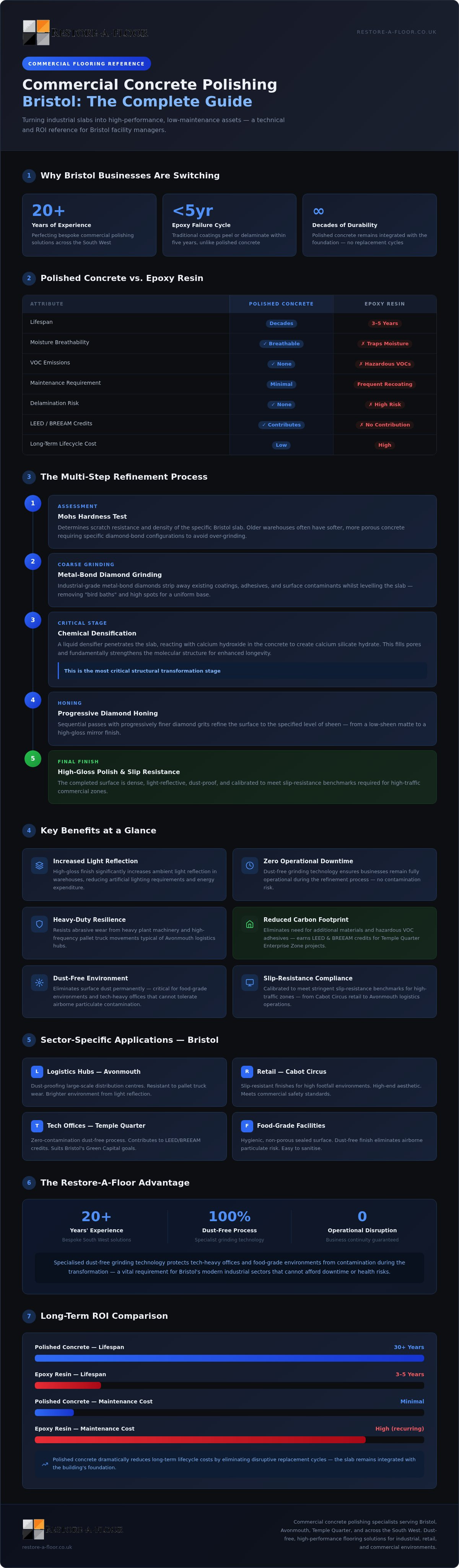
The rise of industrial concrete floor polishing is particularly evident across Bristol's burgeoning logistics hubs in Avonmouth and the refined retail environments of the city centre. Local landlords are increasingly moving away from epoxy resins and vinyl because they recognise the superior return on investment. Whilst traditional coatings often peel or delaminate within five years, a refined concrete surface remains integrated with the building's foundation, dramatically reducing long-term lifecycle costs. This approach ensures that premises remain operational for decades, avoiding the disruptive maintenance cycles that plague businesses using inferior materials.
The Structural Advantages for Bristol Businesses
In large-scale warehouses, the high-gloss finish significantly increases ambient light reflection, which can lower artificial lighting requirements and associated energy expenditure. The resulting surface is exceptionally resilient, resisting the abrasive wear caused by heavy plant machinery and high-frequency pallet truck movements. We've seen local firms benefit from floors that don't just look better, but actually contribute to a safer, brighter working environment. Concrete densification is a chemical process where a liquid hardener penetrates the slab to fill pores and increase surface density, fundamentally strengthening the concrete's molecular structure for enhanced longevity.
Sustainable Flooring in the Temple Quarter Enterprise Zone
As Bristol pursues its "Green Capital" ambitions, particularly within the Temple Quarter Enterprise Zone, sustainable construction has become a priority for every new development. Polishing the existing slab reduces the carbon footprint of refurbishments by eliminating the need for additional materials and the hazardous VOC-emitting adhesives found in traditional flooring. These projects often contribute valuable credits toward LEED and BREEAM certifications, making it an attractive choice for environmentally-conscious developers. Crucially, our specialised dust-free process ensures that tech-heavy offices and food-grade environments remain free from contamination during the transformation, a vital requirement for Bristol's modern industrial sectors that cannot afford downtime or health risks.
The Industrial Concrete Floor Polishing Process: A Technical Reference
The execution of high-calibre commercial concrete polishing Bristol relies on a methodical, engineering-led approach that begins long before the first grinder touches the surface. We start every project with a Mohs hardness test to determine the scratch resistance of the local concrete slab. This assessment is vital because Bristol's industrial floors vary significantly in density; older warehouses often feature softer, more porous concrete that requires specific diamond-bond configurations to avoid over-grinding. By identifying the slab's hardness early, we ensure the selection of metal-bond diamonds is perfectly calibrated for the specific substrate, preventing unnecessary wear and ensuring a uniform level of refinement.
Once the assessment is complete, the coarse grinding phase begins. This stage involves using industrial-grade metal-bond diamonds to strip away existing coatings, adhesives, or surface contaminants whilst levelling the slab to remove "bird baths" and high spots. Following this, we apply a liquid chemical densifier. This stage is the most critical part of the structural transformation. The densifier reacts with the calcium hydroxide in the concrete to create calcium silicate hydrate, which fills the pores and hardens the molecular structure of the surface. If you're unsure how your current slab will react to this treatment, our specialists provide detailed concrete floor polishing consultations to determine the optimal chemical path for your facility.
The final stage is the fine polishing process, where we transition from metal-bond to resin-bond diamonds. We progress through a series of increasingly fine grits, typically ranging from 100 to 3000, depending on the desired lustre. This mechanical refinement doesn't rely on topical sealers that can peel; instead, the shine is a direct result of the concrete surface being honed to a microscopic level of smoothness.
Understanding Finish Levels: From Matte to High-Gloss
Choosing the correct finish level is a balance between operational requirements and visual impact. Level 1 (Matte) provides a clean, non-reflective surface that is ideal for heavy-duty industrial warehouses in Avonmouth where utility is the primary concern. Level 2 (Satin) is the "sweet spot" for many Bristol retail environments, offering a subtle sheen that hides scuffs whilst maintaining a professional appearance. For showrooms or corporate centres, Levels 3 and 4 deliver a high-gloss, mirror-like finish that maximises light reflection and projects a premium brand image.
Aggregate Exposure Options for Bespoke Results
The depth of our initial grind determines the final visual pattern of the floor. A "Cream" finish involves polishing only the surface paste, resulting in a consistent, minimalist look with no visible stones. "Salt and Pepper" exposure is achieved by lightly grinding the surface to reveal the tips of the fine aggregate, creating a sophisticated, speckled effect. For a bold, terrazzo-style appearance, we perform a deep "Full Aggregate" grind, exposing the larger stones within the concrete to create a striking architectural feature for commercial spaces.
Commercial Concrete Polishing vs. Epoxy Resin: Making the Right Choice
Choosing between a mechanical finish and a topical coating is one of the most consequential decisions for any Bristol facility manager. Whilst epoxy resin was once the default for industrial environments, the long-term performance of commercial concrete polishing Bristol has shifted the market preference. The fundamental difference lies in the structural integration; polished concrete is a refinement of the existing slab, whereas epoxy is a separate layer bonded to the surface. This distinction dictates everything from the floor's lifespan to its daily maintenance requirements.
A primary concern for Bristol businesses is the local climate's impact on floor integrity. Our region's high humidity and damp conditions can lead to hydrostatic pressure building up beneath non-porous surfaces. Polished concrete remains vapour-permeable, allowing the slab to "breathe" and preventing the moisture-related delamination that frequently causes epoxy coatings to bubble and peel. Over a 20-year period, the total cost of ownership (TCO) for a polished surface is significantly lower. Whilst a resin floor may require a full "strip and re-coat" every five to ten years, a refined concrete floor typically only needs a basic "buff and clean" schedule to maintain its high-performance finish.
When to Choose Polished Concrete
Mechanical polishing is the superior choice for high-traffic environments where durability and low maintenance are the highest priorities. It's particularly effective for Bristol developments incorporating underfloor heating, as the dense concrete provides excellent thermal mass and heat distribution. For a deeper dive into the technicalities of this process, see our guide to Expert Concrete Floor Grinding and Polishing. Choose this path if you require:
A lifespan exceeding 20 years with minimal intervention.
Maximum light reflectivity to reduce energy overheads.
A sustainable solution that utilises the building's existing foundation.
When Epoxy Might Be Preferable
Despite the advantages of polishing, certain industrial applications in Bristol still necessitate the use of resin coatings. If your facility handles aggressive chemicals or requires extreme acid resistance, such as in specialised laboratories, a high-build epoxy provides a sacrificial barrier that protects the substrate. Additionally, if an existing slab has suffered severe structural damage or deep pitting, a self-levelling epoxy pour might be the only way to achieve a flat surface. These coatings are also favoured in wet-process manufacturing zones where specific high-friction textures are mandated by safety regulations to prevent slips in constantly saturated conditions.
Sector-Specific Guidance for Bristol Commercial Properties
Bristol's diverse commercial ecosystem demands flooring solutions that are as varied as the sectors they serve. From the high-end retail corridors of Cabot Circus to the expansive industrial hubs of Avonmouth, commercial concrete polishing Bristol provides a versatile foundation that adapts to specific operational pressures. A showroom floor requires a different mechanical approach than a distribution centre, yet both benefit from the inherent strength of a refined slab. Our experience across the South West has shown that success lies in aligning the grit level and densification process with the unique environmental demands of each property type.
Retail environments in the city centre must balance high-gloss aesthetics with strict BS EN slip-resistance standards. Polishing provides that mirror finish whilst maintaining the required friction coefficients for public safety, even in high-traffic zones. Similarly, educational institutions and public buildings benefit from a surface that is virtually indestructible. Polished concrete eliminates the need for harsh cleaning chemicals, making it a healthier choice for schools and universities whilst providing a surface that won't chip or stain under heavy student footfall.
Industrial Concrete Polishing for Avonmouth Logistics
The logistics sector in Avonmouth operates under some of the most punishing conditions in the region. These facilities require floors that can withstand constant heavy forklift traffic and the abrasive movement of pallets without dusting or cracking. We prioritise joint stabilisation and precision repair to ensure a seamless surface that protects both the machinery and the substrate. For facility managers planning a budget, reviewing the Cost of Polished Concrete Floor Cardiff serves as an excellent reference point for regional benchmarking and project forecasting.
Modern Office Refurbishments in Bristol City Centre
In Bristol city centre, modern office refurbishments are increasingly moving away from traditional carpets in favour of polished concrete to highlight original architectural features. In creative hubs like Stokes Croft, this "industrial chic" look is often paired with exposed brickwork and high ceilings. Beyond aesthetics, these floors offer superior acoustic performance when integrated with modern design elements and are exceptionally easy to sanitise in high-occupancy professional environments. The reflective nature of the finish also aids in distributing natural light deeper into office floor plates, contributing to a more vibrant workspace.
To understand how these sector-specific benefits apply to your premises, we recommend booking one of our bespoke floor assessments to evaluate your slab's potential.
The Restore-A-Floor Advantage: Dust-Free Commercial Polishing
With over 20 years of industry experience, Restore-A-Floor has established itself as a trusted advisor for commercial concrete polishing Bristol. Our legacy across Cardiff, Swansea, and the wider South West is built on a commitment to precision and a focus on high-end results. We understand that for an active business, the prospect of floor restoration can be daunting due to potential disruption. This is why we've invested in specialised dust-free grinding and polishing technology, ensuring that your operational environment remains clean and uncontaminated throughout the project.
Our bespoke project management approach covers every detail from initial sub-floor preparation to the final application of protective seals. We don't just provide a service; we act as an active partner, carefully managing the workflow to minimise downtime. By utilising advanced HEPA-filtered extraction systems connected directly to our grinding equipment, we capture 99.9% of silica dust at the source. This meticulous attention to cleanliness allows us to work alongside other trades or within sensitive environments without compromising health or safety.
Expertise in Large-Scale Industrial Projects
Our qualified teams possess the technical proficiency to manage industrial floor restorations exceeding 1,000 sqm. We utilise industrial-grade planetary grinders that provide the necessary torque and weight to achieve a perfectly level, high-performance finish on challenging slabs. We maintain an unwavering commitment to health and safety on every Bristol construction site, adhering to strict professional standards and accreditation requirements. This ensures that large-scale projects are delivered on time, within budget, and to a standard that reflects our pride in craftsmanship.
Requesting Your Commercial Quotation
The journey toward a refined environment begins with a comprehensive site survey. During this process, our experts evaluate the condition of your Bristol premises, looking for structural defects, moisture levels, and the specific hardness of the concrete. This thorough assessment allows us to provide transparent pricing and fixed-quote reliability, eliminating the risk of unexpected costs. We lead you through the technical journey, ensuring the final outcome aligns perfectly with your requirements.
Securing Your Industrial Foundation for the Future
Transforming your facility's floor from a basic structural slab into a high-performance asset requires technical precision and a deep understanding of local materials. Throughout this guide, we've explored how mechanical refinement offers a superior lifespan of over 20 years, far outperforming traditional coatings in both durability and moisture breathability. Choosing commercial concrete polishing Bristol ensures that your premises benefit from maximum light reflectivity and a maintenance-free finish that meets the highest safety standards. Our specialised dust-free refinishing process ensures these improvements are achieved without contaminating your workspace or disrupting critical operations.
With over 20 years of experience serving Bristol, Cardiff, and Swansea, Restore-A-Floor is dedicated to delivering bespoke solutions that prioritise long-term value. We're ready to lead you through the technical journey of upgrading your commercial environment. Take the first step toward a more resilient and aesthetically striking workspace today. Book a Free Site Survey for Commercial Concrete Polishing in Bristol and discover the potential hidden within your existing foundation.
Frequently Asked Questions
How much does commercial concrete polishing cost in Bristol per square metre?
Pricing for commercial concrete polishing Bristol is determined by several project-specific variables rather than a flat rate. Factors such as the current condition of the slab, the desired aggregate exposure, and the total square meterage significantly influence the final investment. Because every industrial environment presents unique challenges, we provide bespoke quotations following a thorough site survey. This ensures you receive an accurate, fixed-price proposal that reflects your specific operational requirements and finish levels.
Is polished concrete too slippery for a busy Bristol retail shop?
Polished concrete is not inherently more slippery than other hard floor surfaces and often exceeds the required slip-resistance standards. During the mechanical refinement process, we can adjust the finish to meet specific BS EN benchmarks for safety in high-traffic retail environments. Even with a high-gloss aesthetic, the surface maintains sufficient friction for public use. We also offer specialised anti-slip treatments for zones prone to moisture, ensuring a safe environment for both staff and customers.
How long does the industrial concrete polishing process take to complete?
The duration of a project depends on the floor's size and the complexity of the refinement required. A standard 500 sqm industrial unit typically takes between five to seven working days to complete from initial preparation to the final seal. We provide a detailed project timeline during the consultation phase to help you manage operational expectations. Our teams work methodically to ensure the transition is seamless, allowing your business to return to full capacity as quickly as possible.
Can any commercial concrete floor be polished, regardless of age?
Most commercial concrete floors can be polished successfully, provided they are structurally sound and have a minimum compressive strength. Older slabs often possess a unique character that, when refined, creates a striking industrial aesthetic. If a floor has deep cracks or significant pitting, we perform precision repairs and joint stabilisation before the polishing begins. We conduct a Mohs hardness test on every project to determine if the concrete is suitable for mechanical refinement and to select the correct diamond bonds.
What is the difference between a "grind and seal" and true polished concrete?
True polished concrete is a mechanical process that hones the slab's surface using progressively finer diamond grits until the desired lustre is achieved. In contrast, a "grind and seal" involves a coarse grind followed by the application of a topical film or coating to create an artificial shine. Whilst the latter is often faster to install, it lacks the extreme durability and breathability of a mechanically polished floor, which relies on the concrete's own density for its performance.
Does polished concrete require special cleaning products for industrial use?
Maintaining a polished surface is straightforward but requires the use of pH-neutral cleaning agents to preserve the densified finish. Harsh acidic or alkaline chemicals can dull the shine over time by reacting with the concrete's molecular structure. For high-traffic industrial zones, we recommend using a microfibre mopping system or an automatic scrubber equipped with non-abrasive pads. This simple routine prevents the build-up of grit and ensures the floor retains its light-reflective properties for decades without the need for waxing.
Is the polishing process really dust-free for sensitive environments?
Our refinishing process is specifically designed to be dust-free through the use of advanced HEPA-filtered extraction systems. These industrial vacuums are connected directly to our planetary grinders, capturing 99.9% of airborne particles at the point of creation. This level of containment is essential for Bristol's technology sectors and food-grade environments where contamination is not an option. You don't need to worry about extensive clean-up or damage to sensitive equipment, as our methodical approach keeps the workspace pristine.
Can you polish concrete floors in existing Bristol office buildings?
Yes, we frequently perform commercial concrete polishing Bristol in existing office buildings during refurbishments or fit-outs. The process is ideal for modernising professional spaces whilst highlighting original architectural features. Because our equipment is designed for precision and cleanliness, we can work in multi-storey buildings with minimal disruption to adjacent tenants. The resulting surface is not only aesthetically pleasing but also improves indoor air quality by eliminating the dust and allergens often trapped in traditional carpets or vinyl.


Comments