

Commercial Polished Concrete Contractors Haverfordwest: The 2026 Buying Guide
A shiny concrete floor isn't necessarily a durable one; commercial longevity relies on systematic mechanical diamond refinement rather than superficial topical sealers that quickly scuff and peel. For facility managers, retail operators, and specifiers across Pembrokeshire, sourcing experienced commercial polished concrete contractors Haverfordwest businesses can trust often presents immediate friction. You shouldn't have to wrestle with confusing contractor tenders, lingering airborne dust, or the uncertainty of whether your existing slab requires a fresh overlay or deep grinding.
We understand that safeguarding operational continuity whilst securing a resilient, low-maintenance surface is vital to your business. This 2026 buying guide provides a transparent framework to evaluate local contractors, select the ideal aggregate exposure and densification process, and commission a turnkey finish that meets strict commercial standards. Ahead, you'll discover how to navigate technical specifications, manage dust-free planetary grinding requirements, and ensure your commercial installation completes on schedule.
Table of Contents
Commercial Polished Concrete in Haverfordwest: Local Performance Standards
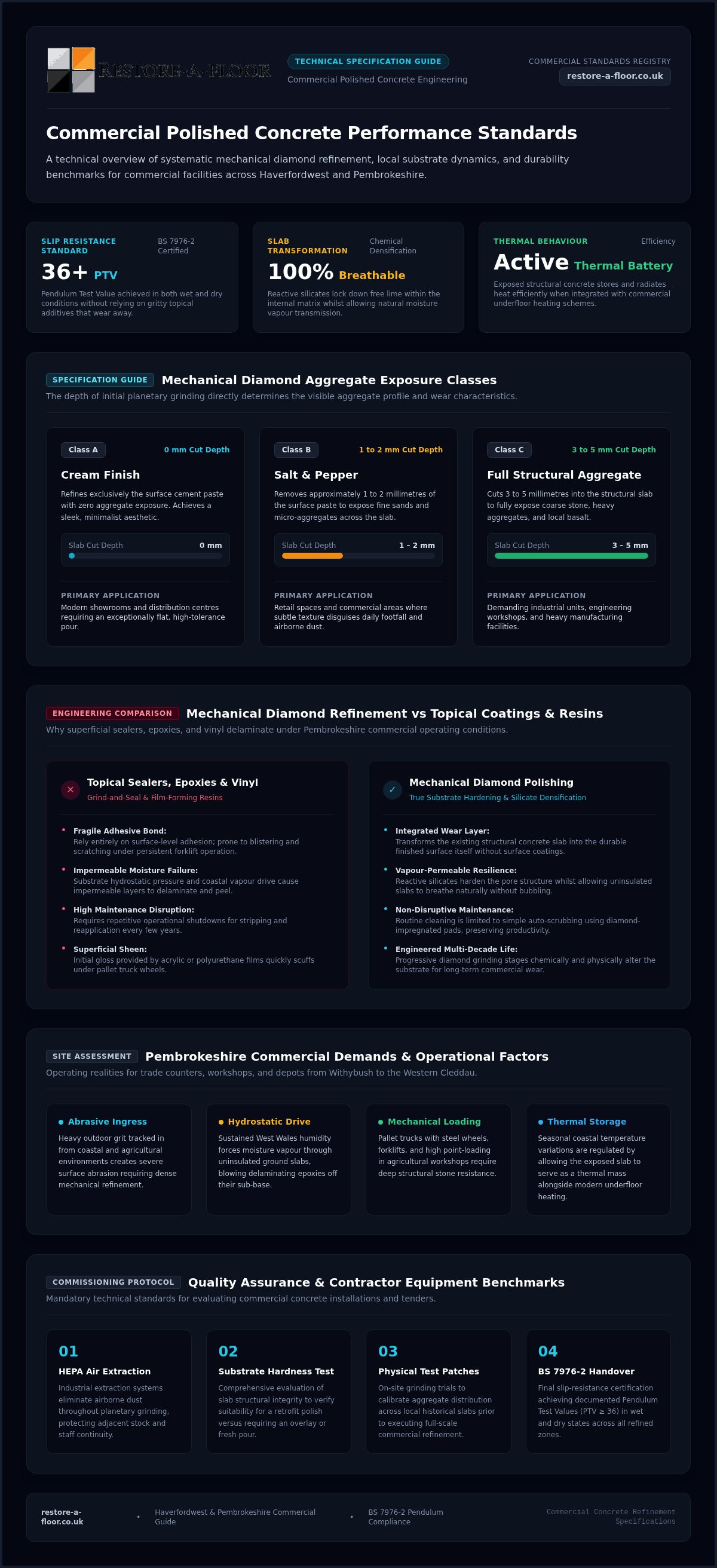
Commercial flooring across Pembrokeshire faces operating conditions rarely accounted for by generic national specifications. From busy logistics depots on Withybush Industrial Estate to retail spaces near the Western Cleddau, facilities must balance rigorous physical wear with coastal weather. Engaging established commercial polished concrete contractors Haverfordwest managers trust ensures your installation accounts for heavy abrasive grit tracked in from outside, seasonal temperature swings, and maritime dampness. Crucially, commercial compliance demands proven safety; mechanical diamond refinement delivers certified slip resistance under BS 7976-2 pendulum testing, routinely achieving a Pendulum Test Value (PTV) of 36 or above in both wet and dry conditions without relying on gritty topical additives that wear away.
Demands of Pembrokeshire Commercial and Industrial Properties
Local trade counters, workshops, and agricultural engineering facilities endure unrelenting mechanical stresses, from steel-wheeled pallet trucks to concentrated point-loading. West Wales also experiences sustained ambient humidity that creates significant moisture vapour drive through uninsulated or aging ground slabs. While impermeable floor finishes fail under this hydrostatic pressure, the multi-stage polished concrete process densifies the internal matrix using reactive silicates. This reaction locks down free lime while allowing the concrete to breathe naturally. Furthermore, exposed concrete acts as an exceptional thermal battery, storing and radiating heat efficiently when paired with modern commercial underfloor heating schemes.
The Longevity Advantage Over Epoxies and Vinyl
Traditional surface finishes such as resin epoxies and commercial vinyl rely entirely on fragile adhesive bonds. When subjected to persistent forklift traffic or underlying vapour migration, these superficial layers blister, scratch, and delaminate from the sub-floor. Mechanical diamond polishing transforms the existing structural slab into the finished wear layer itself. By working with specialist commercial polished concrete contractors Haverfordwest facilities avoid the costly cycle of clearing premises for floor stripping and recoating every few years. Ongoing maintenance is reduced to simple, non-disruptive auto-scrubbing with diamond-impregnated pads, protecting bottom-line productivity.
Specification Guide: Aggregate Exposure, Sheen Levels, and Densification
Specifying a commercial floor requires understanding the distinct difference between a topical "grind and seal" coating and true mechanical polishing. A grind-and-seal application merely spreads an acrylic or polyurethane film over roughly abraded concrete; it offers quick initial gloss but remains vulnerable to delamination under pallet truck wheels. In contrast, authentic mechanical diamond polishing aligns with industry-recognised contractor technical guidelines to refine the concrete slab itself through progressive diamond grit stages. By chemically transforming the substrate rather than painting over it, commercial polished concrete contractors Haverfordwest businesses hire create an inherently hardened, non-porous floor engineered for decades of service.
Selecting Aggregate Exposure for Your Haverfordwest Facility
The depth of initial planetary grinding determines which internal layer of the concrete is revealed:
Cream Finish (Class A): Refines only the surface cement paste with zero aggregate exposure. This sleek, minimalist look suits modern showrooms and distribution centres, though it requires an exceptionally flat, high-tolerance pour.
Salt and Pepper (Class B): Removes roughly 1 to 2 millimetres of the surface to reveal fine sands and micro-aggregates. It provides subtle visual texture that easily hides daily footfall and dust.
Full Structural Aggregate (Class C): Cuts 3 to 5 millimetres deep into the slab to expose coarse stone and local basalt. This heavy-duty profile delivers maximum wear resistance in demanding industrial units.
Existing slab condition directly dictates the achievable aggregate consistency. Uneven historical slabs across Pembrokeshire may yield variable exposure across low and high spots.
Sheen Ratings and Penetrative Chemical Densification
Surface reflectivity is tailored through mechanical polishing stages rather than waxes:
Level 1 (Ground Matte): Honed flat to a non-reflective, utilitarian profile.
Level 2 (Satin/Low Sheen): Diffuses overhead lighting softly, hiding scuffs in busy commercial spaces.
Level 3 and 4 (Semi-Gloss to High-Gloss): Produces high Distinctness-of-Image (DOI) clarity, maximising natural daylight in retail venues.
Crucially, achieving long-term density requires chemical hardeners. Penetrating liquid lithium and colloidal silicates react directly with free lime (calcium hydroxide) within the paste, generating an insoluble calcium silicate hydrate (CSH) crystalline matrix. This molecular transformation closes microscopic pores, permanently resisting oil ingress, rubber tyre marks, and chemical spills. Engaging seasoned specialists for your concrete floor polishing guarantees that both densification chemistry and diamond stages are calibrated precisely for your facility's operational load.
Evaluating Commercial Concrete Slabs: Retrofit vs New Pour in West Wales
Before committing to a concrete specification, commercial property owners must determine whether an existing slab can be directly polished or if extensive structural remediation is required. Every retrofit begins with an objective assessment of surface hardness using the Mohs mineral scale. Commercial slabs in Haverfordwest typically test between 5 and 7; softer slabs beneath 5 drink excessive quantities of liquid densifier and demand soft-bond metal diamond segments, whereas harder slabs require aggressive, soft-matrix tooling to cut cleanly. Aligning with recognized UK polished concrete standards, professional contractors diagnose these variables early. When an old industrial floor shows structural degradation, following a systematic concrete floor grinding and polishing procedure dictates whether mechanical rejuvenation or a rapid-curing cementitious overlay is the more viable path.
Structural Slab Diagnosis: Cracks, Spalls, and Joint Remediation
Decades of forklift impact and thermal shifting across Pembrokeshire warehouses leave legacy damage. Spalled contraction joints must be rebuilt using colour-matched, semi-rigid polyurea joint fillers. These fillers cure rapidly, supporting wheel loads across adjacent slab shoulders without brittle fracturing. Static micro-cracks can be stabilised via low-viscosity structural epoxy or cementitious micro-grouting injection, which seals fractures against dirt and water ingress before initial grinding commences. Heavy planetary grinders running aggressive 16-to-30-grit metal diamonds then flatten curbed joint edges, eliminating tripping hazards and creating a uniform plane.
Moisture Testing and Sub-Floor Remediation in Coastal Climates
Coastal geography introduces distinctive sub-base dynamics. Commercial premises throughout Haverfordwest frequently sit above damp ground without functioning damp-proof membranes (DPM). Contractors must conduct in-situ relative humidity (RH) sleeve tests to assess moisture drive. True mechanical diamond polishing remains breathable, allowing elevated vapour emissions to dissipate without blistering. However, if residual tile adhesives, bitumen, or oil-slick contaminants saturate the pores, heavy-duty mechanical extraction is essential. When severe slab dusting or widespread contamination prevents direct refinement, competent commercial polished concrete contractors Haverfordwest businesses rely on can apply moisture-tolerant primers and industrial screed toppings to establish a pristine canvas for subsequent diamond polishing.
How to Choose Commercial Polished Concrete Contractors in Haverfordwest
Procuring specialist flooring services demands a rigorous vetting process that separates seasoned industrial technicians from general builders armed with adapted domestic equipment. When evaluating commercial polished concrete contractors Haverfordwest businesses should verify that candidate firms possess dedicated heavy industrial machinery, verified health and safety protocols, and proven commercial case studies within South and West Wales. Asking the right technical questions early safeguards your property from failed inspections, prolonged operational disruption, and sub-standard surface longevity.
Essential Machinery and Dust Extraction Standards
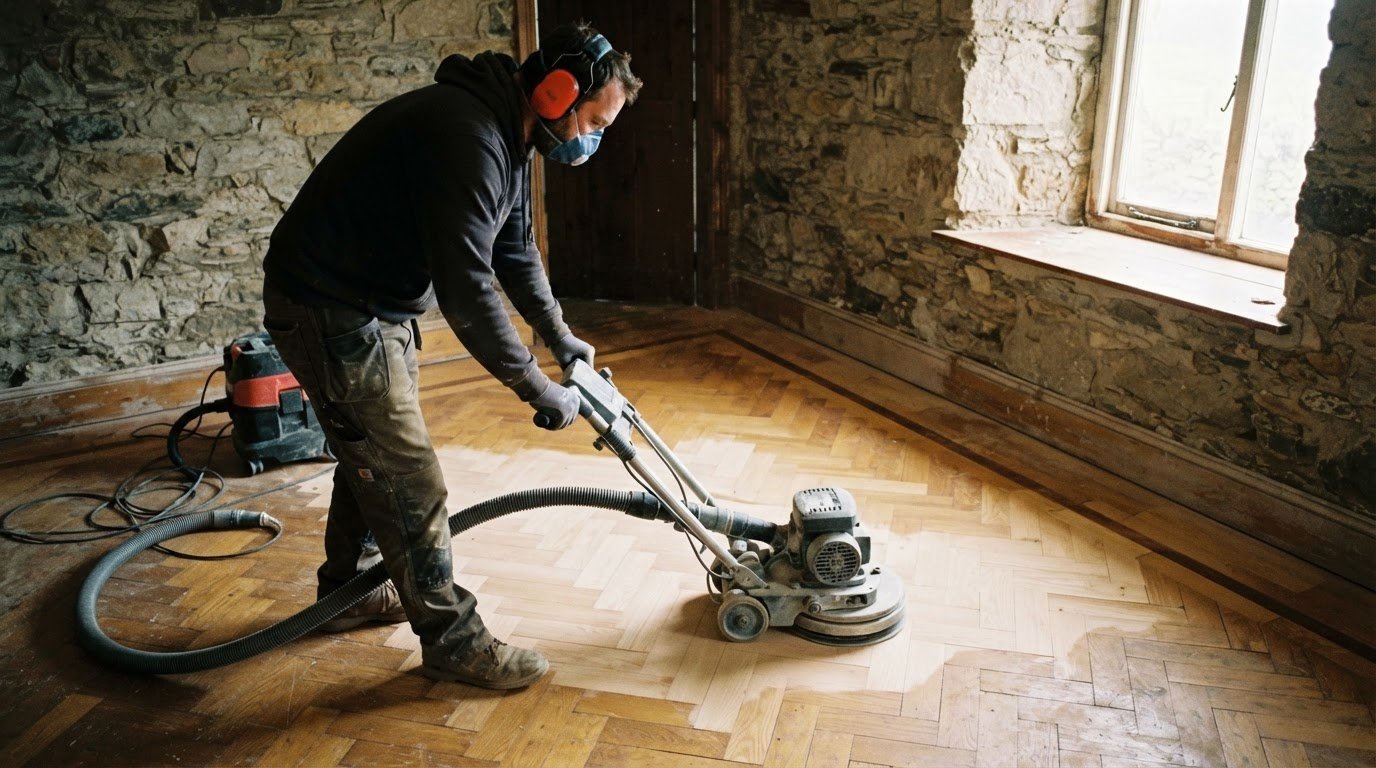
Commercial concrete refinement requires heavy-mass, multi-head planetary grinders weighing upwards of 350 to 500 kilograms. Light single-head rotary buffers simply follow existing floor undulations, merely polishing the peaks while leaving troughs untouched. True floor flatness and consistent aggregate reveal demand multi-head planetary pressure. Crucially, dry mechanical diamond cutting produces fine respirable crystalline silica (RCS). Professional contractors deploy industrial three-stage dust extractors fitted with certified HEPA H14 filtration, capturing 99.995% of micro-particles at source. This closed-loop system preserves sensitive stock, protects electronic equipment, and maintains indoor air quality throughout live trading environments.
Contractor Accreditations, RAMS, and Operational Flexibility
Strict site safety protocols are non-negotiable on commercial premises:
Site-Specific RAMS: Demand comprehensive Risk Assessment and Method Statement documentation addressing machinery noise, 3-phase power delivery, and hazardous zone cordoning.
CSCS and Commercial Insurance: Verify that on-site technicians carry valid CSCS cards and that the firm holds comprehensive public and employer's commercial liability cover.
Flexible Scheduling: Facilities cannot afford costly daytime closures. Check whether the contractor can accommodate phased section installations or out-of-hours scheduling to keep your trade doors open.
Vetting Regional Expertise vs Remote National Sub-Contractors
Remote national agencies frequently secure contracts online before sub-contracting the physical work to third-party operators with little local accountability. This practice leads to inflated communication breakdowns, inconsistent finishing standards, and hefty regional travel surcharges. Partnering with established West Wales professionals ensures direct accountability and dedicated customer support from initial survey to final burnish. Bringing over 20 years of commercial surface restoration experience across Pembrokeshire, our in-house team eliminates sub-contractor delays. When you are ready to plan your commercial project, contact Restore-A-Floor for specialist concrete advice and arrange a comprehensive on-site technical consultation.
The Commissioning Process: From On-Site Survey to Handover
Commissioning a heavy-duty mechanical diamond polish involves a structured, sequential workflow designed to eliminate site surprises and deliver predictable results. Reputable commercial polished concrete contractors Haverfordwest businesses rely on don't begin by firing up machinery on day one. Instead, the process starts with an exhaustive physical site audit. Technicians examine slab flatness tolerances, inspect joint integrity, test 3-phase power distribution, and establish extraction routing. A vital preliminary step involves installing an on-site mock-up patch in an inconspicuous area. This physical sample lets you inspect the exact aggregate reveal, edge-detail blending, and gloss level on your actual concrete matrix before site-wide grinding begins.
Step-by-Step Commercial Project Lifecycle
Once the test patch is approved and logistics are locked down, the mechanical transformation proceeds through four rigorous phases:
Coarse Diamond Grinding: Industrial planetary equipment fitted with coarse metal-bond diamond tooling removes surface contaminants, corrects minor floor imperfections, and reveals the desired aggregate depth.
Grouting and Pore Bridging: A specialised cementitious pore filler is worked across the entire slab to fill micro-pinholes, shrinkage fissures, and air pockets exposed during initial grinding passes.
Chemical Densification: Liquid lithium or colloidal silicates are saturated into the open matrix, triggering an internal reaction with free calcium hydroxide to harden the upper wear layer.
Progressive Resin Polishing: Technicians cycle through successively finer resin-bond diamond pads, honing the surface from a smooth matte profile up to your specified commercial lustre.
Final Handover, Slip-Resistance Certification, and Ongoing Care
Finishing a commercial installation extends beyond mechanical refinement. The hardened slab is treated with a breathable, penetrating stain protector and buffed using high-speed burnishing equipment to lock down oil and fluid resistance. Before final sign-off, technicians execute calibrated pendulum testing to certify that the floor complies fully with BS 7976-2 low-slip standards under both dry and wet conditions.
You then receive an operations and maintenance manual tailored to your environment, specifying pH-neutral daily cleaning solutions and diamond maintenance pads that clean the floor without dulling its lustre. Working directly with Restore-A-Floor ensures your Haverfordwest facility benefits from over two decades of local technical knowledge, delivering turnkey results on time and built to endure demanding trade conditions.
Secure Long-Term Slab Performance for Your Pembrokeshire Business
Transforming an industrial or retail facility shouldn't mean gambling on temporary coatings that peel and fail. Long-term commercial resilience comes from systematic diamond grinding, chemical densification, and meticulous joint stabilisation. Choosing experienced commercial polished concrete contractors Haverfordwest facility managers trust ensures your installation meets rigorous BS 7976-2 slip-resistance standards while safeguarding everyday operational continuity.
Restore-A-Floor brings over 20 years of bespoke commercial surface restoration experience across South and West Wales. Backed by heavy industrial planetary machinery, certified HEPA extraction systems, and end-to-end project management, our local team handles everything from initial slab hardness testing to final high-speed burnishing. Take control of your commercial interior today: request your Haverfordwest commercial site survey and tailored proposal to create an enduring, low-maintenance foundation for your business.
Frequently Asked Questions
How long does a commercial polished concrete installation take in Haverfordwest?
Most commercial projects require between three and five operational days, depending on slab dimensions and structural repairs. Initial metal-bond grinding and crack injection typically consume the first day, followed by penetrative chemical densification and progressive resin polishing stages. Highly complex aggregate reveals or extensive joint reconstruction can extend this timeline, but direct project planning ensures established commercial polished concrete contractors Haverfordwest managers work with keep downtime strictly contained.
Is polished concrete slippery for retail customers or industrial staff?
Can damaged, pitted industrial concrete slabs in Pembrokeshire be polished successfully?
Yes, severely damaged industrial slabs can usually be revitalised using deep diamond remediation. Technicians grind past surface spalling and oil contamination, then apply high-strength cementitious grouting and polyurea joint fillers to reconstruct damaged transitions and pinholes. If testing indicates structural carbonation or excessive substrate deterioration across an older Pembrokeshire building, contractors can install a rapid-curing commercial cement overlay before executing the diamond polishing process.
What is the practical difference between diamond polished concrete and an epoxy floor coating?
Diamond polished concrete refines the existing structural slab into the finished wear layer, whereas epoxy applies a topical plastic film over the surface. Epoxy coatings eventually scratch, blister, and delaminate under heavy forklift tyres or rising dampness, requiring total replacement every few years. Mechanical polishing permanently densifies the concrete matrix from within, creating a breathable, rock-hard surface that won't peel or require chemical stripping.
Can commercial concrete polishing be completed out of hours to avoid business downtime?
Yes, experienced commercial polished concrete contractors Haverfordwest businesses hire routinely plan work around active trade cycles. Dedicated teams can deploy during night shifts, bank holidays, or staged weekend phases to keep facilities operating safely during normal business hours. Because industrial dry grinding utilises sealed HEPA-filtered vacuum extraction systems, technicians work cleanly without emitting airborne silica dust into adjacent trading zones or contaminating retail inventory.
How does coastal Pembrokeshire weather affect commercial polished concrete installations?
Coastal dampness and fluctuating maritime humidity frequently cause topical coatings to blister through hydrostatic pressure. Polished concrete bypasses this issue because mechanical refinement and penetrating silicate densifiers leave the slab breathable, allowing vapour drive to dissipate naturally. However, wet and cold winter air can lengthen the cure times of patching grouts and pore fillers, requiring technicians to carefully monitor ambient building temperatures during application.
What routine cleaning is required to maintain the high-sheen finish on commercial slabs?
Daily commercial maintenance simply requires sweeping away abrasive grit followed by damp mopping or automatic scrubbing using clean water and a pH-neutral cleaner. You should avoid acidic solutions, bleach, and citrus detergents, as harsh chemicals gradually etch the microscopic diamond polish. High-traffic trade facilities can preserve optimal surface lustre and stain resistance over decades by periodically burnishing high-wear lanes with fine-grit diamond-impregnated cleaning pads.

Comments