

Residential Parquet Floor Restoration in Cardiganshire: The Complete Guide
Did you know that the average relative humidity in Ceredigion reaches a staggering 83%? For homeowners throughout the region, this damp coastal climate presents a significant challenge for timber maintenance. You likely appreciate the character that original woodwork brings to your home, yet the prospect of residential parquet floor restoration Cardiganshire can feel daunting. Many residents hesitate because they fear a home engulfed in fine sanding dust or worry that the cost of bespoke repairs for missing blocks will be prohibitive. It's a common concern, especially when you want to honour the heritage of a Victorian terrace or a maritime cottage without the stress of a messy, invasive process.
We're here to reassure you that a pristine, high-end result is entirely achievable without the typical disruption. This comprehensive guide details how modern dust-free sanding technology and sophisticated, breathable finishes can breathe new life into your flooring whilst protecting it against the West Wales elements. You'll discover expert methods for bespoke block replacement, insights into the latest Cadw heritage guidelines, and advice on selecting finishes that offer maximum durability. By the end of this article, you'll have a clear roadmap to transforming your tired parquet into a stunning architectural feature that adds lasting value to your property.
Table of Contents
The Enduring Appeal of Residential Parquet in Cardiganshire
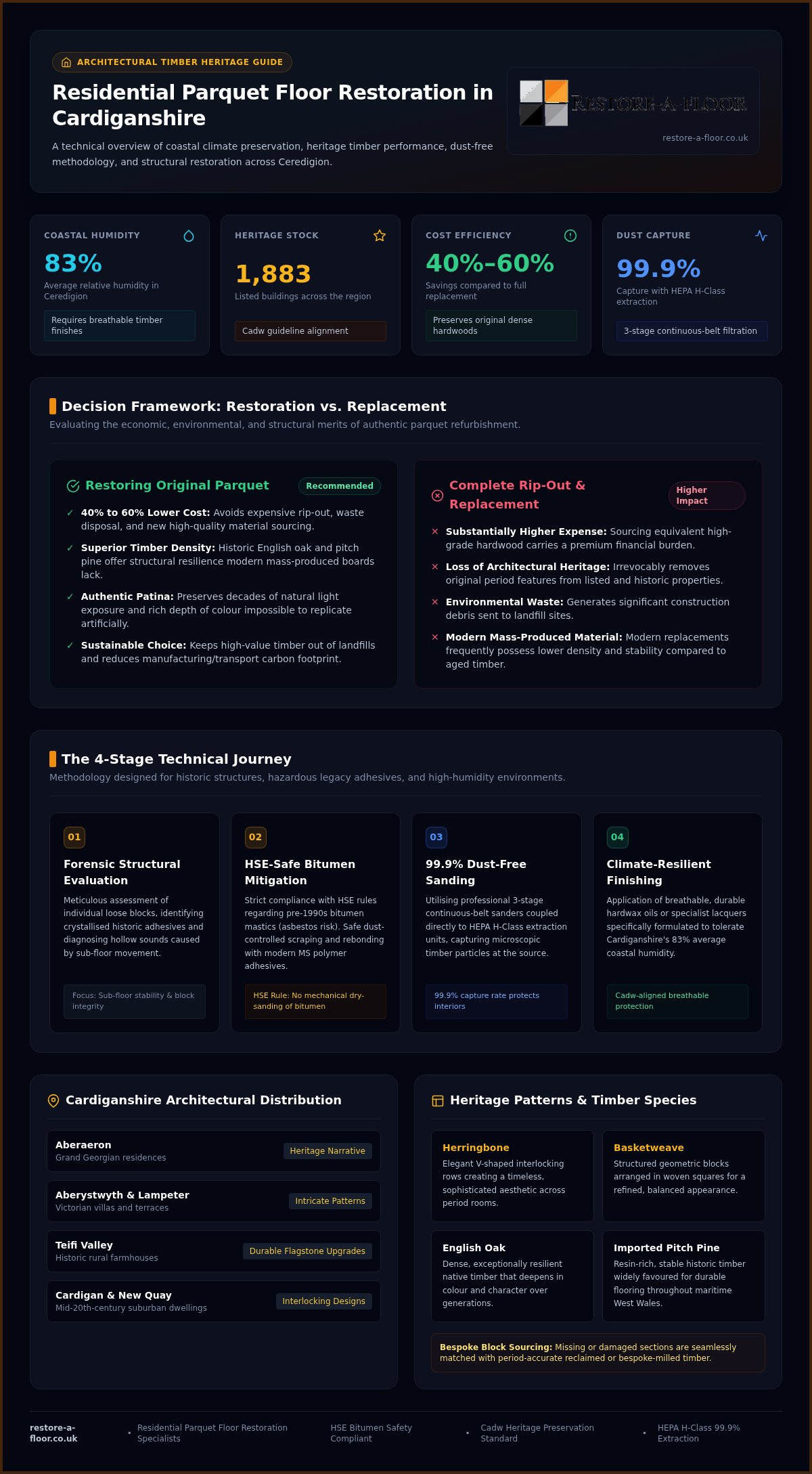
Parquet flooring in Cardiganshire isn't just a surface; it's a historical narrative. From the grand Georgian houses of Aberaeron to the Victorian terraces of Aberystwyth, these floors represent a period of craftsmanship that's difficult to replicate today. Professional residential parquet floor restoration Cardiganshire allows homeowners to honour this legacy whilst ensuring their property remains a functional, modern living space. With approximately 1,883 listed buildings across Ceredigion, the preservation of original timber features is a priority for many who wish to maintain the authentic character of West Wales architecture.
Parquet in Cardiganshire’s Historic Architecture
Victorian villas in Aberystwyth and Lampeter often feature intricate patterns that were once symbols of status and sophistication. In rural farmhouses across the Teifi Valley, parquet was a durable upgrade from simpler flagstones or basic floorboards. By the mid-20th century, decorative patterns like Herringbone and Basketweave became staples in suburban homes in Cardigan and New Quay. This shift saw homeowners moving away from purely utilitarian surfaces toward the ornate, interlocking designs we see today. These floors were built to last, often cut from dense English oak or imported pitch pine that has only grown more resilient with age.
Why Restoration Beats Replacement
Choosing professional refurbishment over a complete rip-out is a decision rooted in both aesthetics and economics. The aged timber found in historic Ceredigion homes possesses a density and stability that modern mass-produced boards often lack. Decades of foot traffic and natural light exposure create a unique patina, a rich depth of colour and character that only time can forge. Restoring these existing blocks is significantly more cost-effective than a full replacement. Research indicates that restoration can save homeowners roughly 40% to 60% compared to the price of sourcing and installing new high-quality hardwood.
Beyond the financial benefits, restoration is the sustainable choice. It keeps high-quality timber out of landfills and avoids the carbon footprint associated with manufacturing and transporting new materials. Whether your home features a classic Herringbone with its elegant V-shaped rows or a structured Basketweave pattern, our residential parquet floor restoration Cardiganshire services ensure these heritage features are preserved. A well-restored floor doesn't just look spectacular; it acts as a tangible link to the property’s past whilst providing a durable foundation for its future.
The Technical Journey: Professional Parquet Refurbishment
Undertaking residential parquet floor restoration Cardiganshire requires more than just a surface-level sand; it demands a deep understanding of timber behaviour and structural mechanics. Every project begins with a forensic assessment of the floor's integrity. We meticulously check for individual loose blocks and signs of sub-floor movement that could compromise the final result. In many of the region's older properties, the original adhesives have crystallised over decades, leading to the "hollow" sound or slight movement often felt underfoot. Addressing these issues early prevents future failures and ensures the floor remains stable for another generation.
Managing Historic Adhesives and Sub-floors
A critical technical challenge in older West Wales homes is the presence of legacy bitumen adhesives. Prior to the 1990s, these black mastics frequently contained chrysotile asbestos. Under current UK Health and Safety Executive (HSE) regulations, bitumen must never be mechanically dry-sanded or ground, as this releases hazardous fibres into the home. We utilise safe, dust-controlled scraping methods and compatible MS polymer adhesives to re-bond loose blocks securely. Sub-floor preparation serves as the essential foundation for any successful restoration project.
Dust-Free Sanding Technology
Modern extraction systems have completely revolutionised the restoration experience for homeowners. We employ professional 3-stage continuous-belt sanders connected to HEPA H-Class extractors, which achieve a 99.9% dust capture rate. This advanced technology ensures that microscopic timber particles and legacy residues are contained at the source, protecting your family’s health and keeping your soft furnishings pristine. The sanding process is methodical, moving from aggressive coarse grits to level the surface, through to fine-grit polishing that prepares the wood for its final protective coating.
If your floor has missing sections or deep damage, we source reclaimed timber that matches the species and age of your original blocks. This bespoke approach ensures repairs are virtually invisible once the floor is finished. We then perform precision gap filling using a slurry of the floor's own wood flour mixed with high-performance resin, ensuring a perfect colour match across the entire surface. Before the final application, we may use grain-raising techniques to ensure the timber cells are open and ready to bond with your chosen finish. To understand how these technical steps apply to your specific property, you can explore our specialist wood floor sanding and refinishing services for more detail.
Restoration vs. Replacement: A Decision-Making Framework
Deciding whether to salvage an original floor or opt for a modern replacement is a pivotal moment for any renovation project. For those considering residential parquet floor restoration Cardiganshire, the choice often leans heavily toward preservation due to the inherent quality of heritage timber. Original solid wood blocks possess a longevity that modern engineered alternatives struggle to match. Whilst a new floor might offer a quick fix, it often lacks the structural density and historical resonance found in Ceredigion’s period properties. Restoring an existing floor typically saves between 40% and 60% compared to the cost of a full replacement, making it a financially prudent strategy for long-term property maintenance.
When is a Parquet Floor Beyond Saving?
Most parquet floors are remarkably resilient. Original solid blocks often feature a wear layer of 6mm to 10mm above the tongue and groove. Since a professional light sanding only removes approximately 0.75mm to 1mm of timber, a floor can theoretically be restored four to six times over its lifecycle. The primary indicators that a floor might be beyond saving include widespread structural rot or severe, deep-seated water damage that has caused the blocks to delaminate or buckle beyond repair. If you're unsure, professional diagnostics can determine if the timber thickness is sufficient for another refurbishment cycle.
Legislation also plays a significant role in this decision. As of November 2024, the Historic Environment (Wales) Act 2023 is in full effect. For the 1,883 listed buildings in Ceredigion, like-for-like repairs using matching species and traditional methods generally don't require Listed Building Consent. However, replacing an original pitch pine or oak floor with modern boards could be viewed as a material change to the building's character, potentially leading to legal complications with Cadw or the local council. Restoration ensures you remain compliant whilst potentially improving your home's EPC rating through better draught-proofing and modern, breathable sealants.
The Aesthetic Advantage of Restoration
Restoration offers a level of customisation that off-the-shelf products cannot provide. You aren't limited to a manufacturer's colour palette; instead, we can create a bespoke stain that perfectly complements your existing interior joinery. Whether you prefer the bare-timber look of an ultra-matt 2K waterborne polyurethane, popular in Aberystwyth beachfront homes, or the rich, honeyed tones of a traditional hardwax oil, the choice is yours. This process allows for subtle repairs that maintain the floor’s history, ensuring that new blocks are seamlessly integrated into the original pattern. The result is a floor that feels authentic to the property’s heritage whilst meeting the high-performance demands of modern residential life.
Selecting Finishes for the West Wales Climate
Cardiganshire’s unique geography, characterised by the sweeping Cardigan Bay, creates a specific atmospheric challenge for timber. With an annual average relative humidity of 83%, local properties experience significant moisture fluctuations throughout the year. This environmental factor is a primary consideration during residential parquet floor restoration Cardiganshire. Timber is naturally hygroscopic. It absorbs and releases moisture from the air, leading to inevitable expansion and contraction. In the solid-walled stone cottages common in Aberaeron or New Quay, using an inappropriate sealant can trap moisture beneath the surface, potentially causing the wood to cup or the finish to fail prematurely.
Hardwax Oils: The Natural Choice
Micro-porous hardwax oils have become the preferred choice for many historic West Wales residences. These finishes allow the timber to breathe, facilitating a gradual exchange of airborne moisture without the risk of the coating bubbling or cracking. Oils penetrate deep into the wood fibres, enhancing the natural grain and providing a warm, tactile aesthetic that suits period properties. A significant advantage for busy households is the ability to perform spot repairs. If a high-traffic area begins to show wear, you can simply re-apply a small amount of oil to that specific section without the need for a full, disruptive sand-and-seal cycle.
Lacquers and Varnishes for High-Traffic Areas
For high-traffic townhomes in Aberystwyth or properties with pets and children, modern 2-component (2K) waterborne lacquers offer unparalleled protection. These non-toxic coatings create a hard-wearing film that is exceptionally resistant to the abrasive coastal sand and grit often tracked indoors. Modern ultra-matt lacquers provide a contemporary appearance that mimics the look of untreated timber whilst offering superior scratch resistance. These finishes are particularly effective for protecting floors in sunny bay windows, as they often include advanced UV filters that prevent the timber from fading or yellowing under intense Welsh sunlight.
Maintaining your restored floor in a coastal environment requires a proactive approach to ensure longevity. We recommend using pH-neutral cleaners specifically formulated for your chosen finish and avoiding excessive water when mopping, as moisture can seep into the fine gaps between parquet blocks. To ensure your investment remains a stunning architectural asset, you should book a professional floor sanding and refinishing assessment to determine the most suitable protective coating for your property's specific micro-climate. Selecting the right finish today prevents costly remedial work tomorrow, ensuring your parquet remains as durable as it is beautiful.
Bespoke Parquet Restoration Services in Cardiganshire
Choosing the right partner for residential parquet floor restoration Cardiganshire is a decision that impacts the long-term integrity of your home’s heritage. Restore-A-Floor stands as the region’s specialist, bringing over 20 years of industry experience to every project. We understand that your flooring is more than just timber; it’s a significant investment in your property's character. Our commitment to dust-free, high-quality craftsmanship ensures that the restoration process is as clean as it is transformative. By combining traditional techniques with modern technology, we deliver results that honour the past whilst meeting the rigorous standards of contemporary living.
Our Local Expertise and Coverage
Our team possesses a deep familiarity with the diverse property types found across West Wales. Whether you own a maritime merchant’s cottage in New Quay, a Victorian terrace in Aberystwyth, or a historic rural farmhouse near Lampeter, we tailor our approach to the specific architectural requirements of your home. We serve all major towns including Cardigan and the surrounding rural areas, ensuring that specialist restoration is accessible to every homeowner in the county. Our regional presence extends beyond Ceredigion, as seen in our work with wood floor sanding Swansea, demonstrating our ability to manage large-scale restoration projects across the wider area.
The Restore-A-Floor Difference
What sets us apart is our identity as a family-owned business driven by a passion for precision. We don’t believe in quick fixes or generic solutions. Instead, we offer a bespoke service journey that begins with a thorough technical assessment and concludes with a flawless, durable finish. Our choice of premium, eco-friendly finishing products reflects our dedication to your health and the environment, ensuring that your home remains safe and sustainable. We take pride in the following standards:
Proven Track Record: Over two decades of refined technique in handling complex parquet patterns.
Dust-Free Environment: A guarantee of 99.9% dust capture for a clean, mess-free experience.
Expert Guidance: A qualified team that acts as a trusted advisor throughout the restoration journey.
Meticulous Detail: A focus on invisible repairs and precision gap filling for a uniform aesthetic.
Starting your project is a straightforward process designed to provide you with complete confidence. We offer a free, professional quotation that includes a detailed breakdown of the necessary works, from sub-floor stabilisation to the final protective coating. Our goal is to provide a seamless experience that results in a stunning, durable floor that adds tangible value to your property. Contact us today to discuss your requirements and discover how our expertise can revitalise your historic parquet flooring.
Revitalise Your Property’s Architectural Heritage
Restoring your parquet floor is more than a simple renovation; it's an investment in the architectural legacy of your Ceredigion home. By choosing professional refurbishment over replacement, you secure a durable, high-value asset that maintains its character for decades. We've explored the technical necessity of dust-free sanding and the importance of selecting breathable finishes that withstand West Wales' unique coastal humidity. Each step of the process ensures your timber remains resilient against the elements whilst looking spectacular.
Our family-owned team brings over 20 years of specialist experience to every project, providing a full dust-free sanding guarantee that ensures your home remains pristine. When you choose our services for residential parquet floor restoration Cardiganshire, you're partnering with experts who value precision and craftsmanship. Ready to transform your tired timber into a stunning focal point? You can request your free parquet restoration quote today and begin the journey toward a flawless finish. We look forward to helping you preserve the unique beauty of your historic flooring.
Frequently Asked Questions
How long does a typical parquet floor restoration take in a residential home?
A standard residential parquet floor restoration Cardiganshire typically takes between three and five days to complete. The exact duration depends on the room's size and the complexity of required repairs, such as re-bonding loose blocks or sourcing matching reclaimed timber. We allow sufficient time for the methodical multi-stage sanding process and the necessary curing of high-performance finishes. Larger multi-room projects or those requiring extensive sub-floor stabilisation will naturally require a longer timeframe to ensure professional results.
Is parquet floor restoration a messy or dusty process?
Restoration is no longer the invasive, dusty process it once was. We utilise professional continuous-belt sanders connected to HEPA H-Class dust extractors, which achieve a 99.9% capture rate. This advanced technology ensures that microscopic timber particles and legacy residues are contained at the source, protecting your soft furnishings and family’s health. Your home remains clean whilst we work, allowing for a stress-free refurbishment experience that avoids the typical mess associated with traditional sanding methods.
Can you replace individual parquet blocks that are missing or badly damaged?
We specialise in bespoke repairs and can seamlessly replace individual blocks that are missing or structurally compromised. Our team sources reclaimed timber that matches the species, grain, and age of your original floor, whether it’s English oak, pitch pine, or mid-century teak. These replacement blocks are meticulously integrated into the existing pattern, such as Herringbone or Basketweave. Once we perform precision gap filling and apply the final finish, these repairs become virtually indistinguishable from the original flooring.
What is the best way to clean my parquet floor once it has been restored?
Maintaining your floor requires a gentle approach to preserve the protective coating. You should use a pH-neutral cleaner specifically formulated for your chosen finish, whether that is a hardwax oil or a water-based lacquer. We recommend using a damp microfibre mop rather than a soaking wet one, as excessive moisture can seep into the joints between blocks. Regular sweeping to remove abrasive coastal grit and sand is essential for preventing surface scratches in high-traffic West Wales homes.
Do I need to move all my furniture out of the room before you arrive?
The room must be entirely clear of furniture, rugs, and window dressings before the restoration process begins. This allows our technicians to access every inch of the floor and ensures an even, level finish across the entire surface. If you have heavy items or built-in units that cannot be moved, we can discuss specific strategies during your initial assessment. Ensuring the workspace is unobstructed is a critical requirement for achieving the high-end, professional results our clients expect.
Can you change the colour of my parquet floor during the restoration?
You have significant flexibility to customise the aesthetic of your floor during the restoration journey. We can apply bespoke stains to alter the timber’s tone, ranging from light, contemporary oaks to deep, traditional walnuts. This process occurs after the final fine-grit sanding but before the protective seal is applied. We often provide on-site samples on your sanded floor, allowing you to see how different colours react with your specific timber under your home's natural lighting.
Is my floor too thin to be sanded again?
Most original parquet floors feature a substantial wear layer, typically between 6mm and 10mm above the tongue and groove. Since a professional light sanding only removes approximately 1mm of timber, most floors can withstand multiple restorations. However, if a floor has been aggressively sanded in the past, it may become structurally unstable. During our initial assessment, we perform a technical check of the remaining timber thickness to ensure the floor is viable for a safe refurbishment cycle.
How often will I need to refinish my parquet floor in the future?
The longevity of your finish depends on foot traffic and your maintenance routine. In a typical residential setting, a professionally applied lacquer may last between seven and ten years before requiring attention. Hardwax oils might benefit from a maintenance coat every three to five years in high-traffic areas, but they offer the advantage of localised spot-repairing. Regular cleaning and the use of protective pads on furniture legs will significantly extend the interval between full residential parquet floor restoration Cardiganshire cycles.


Comments