

The Resurgence of Chevron Parquet Floor Installation in Bristol: A 2026 Trend Analysis
- info089907
- 2 days ago
- 12 min read
Whilst herringbone has long been the default for traditional charm, the sharp, architectural precision of a chevron pattern is the true hallmark of a sophisticated 2026 interior. You likely appreciate the transformative power of real wood, yet you might feel hesitant about the technical demands of chevron parquet floor installation Bristol, especially when dealing with the uneven sub-floors commonly found in the city's Victorian and Georgian properties. It's a common concern that an amateurish attempt could lead to misaligned points that ruin the aesthetic impact and structural integrity of the entire room.
This article explores why chevron is currently the leading choice for homeowners looking to bridge the gap between historic character and modern minimalism. We'll clarify the distinct geometry that separates chevron from herringbone, detail how bespoke installation overcomes the structural quirks of local period properties, and explain why professional craftsmanship is the only way to ensure your investment lasts for decades. From the shift toward warm, natural oak tones to the vital role of dust-free fitting, we provide the expert guidance needed for a flawless result that's as durable as it is beautiful.
Table of Contents
The Rise of Chevron Parquet Floor Installation in Bristol
Bristol's interior design scene is witnessing a sophisticated evolution. Whilst herringbone has long been a staple in the city's West Country villas, we're seeing a decisive pivot towards the more structured, linear elegance of chevron. This resurgence is not merely a passing fad; it's a calculated design choice for homeowners who want to respect the architectural integrity of their properties whilst introducing a contemporary edge. The resurgence of chevron parquet floor installation Bristol reflects a broader shift towards precision and "Modern Heritage" styling, where 19th-century shells are paired with sharp, geometric floor patterns that feel distinctly 2026.
In neighbourhoods like Clifton, Redland, and Cotham, chevron is increasingly favoured for its ability to complement high ceilings and grand room proportions. Unlike standard planks, the repeating "V" pattern creates a sense of intentionality and direction. Looking back at the history of parquet flooring, this specific pattern was historically reserved for the most opulent European estates. Today, Bristolians are using that same sense of luxury to create "flow" in open-plan kitchen extensions, using the floor's natural "arrow" effect to guide the eye towards garden views or architectural focal points.
Chevron vs. Herringbone: Why the Distinction Matters
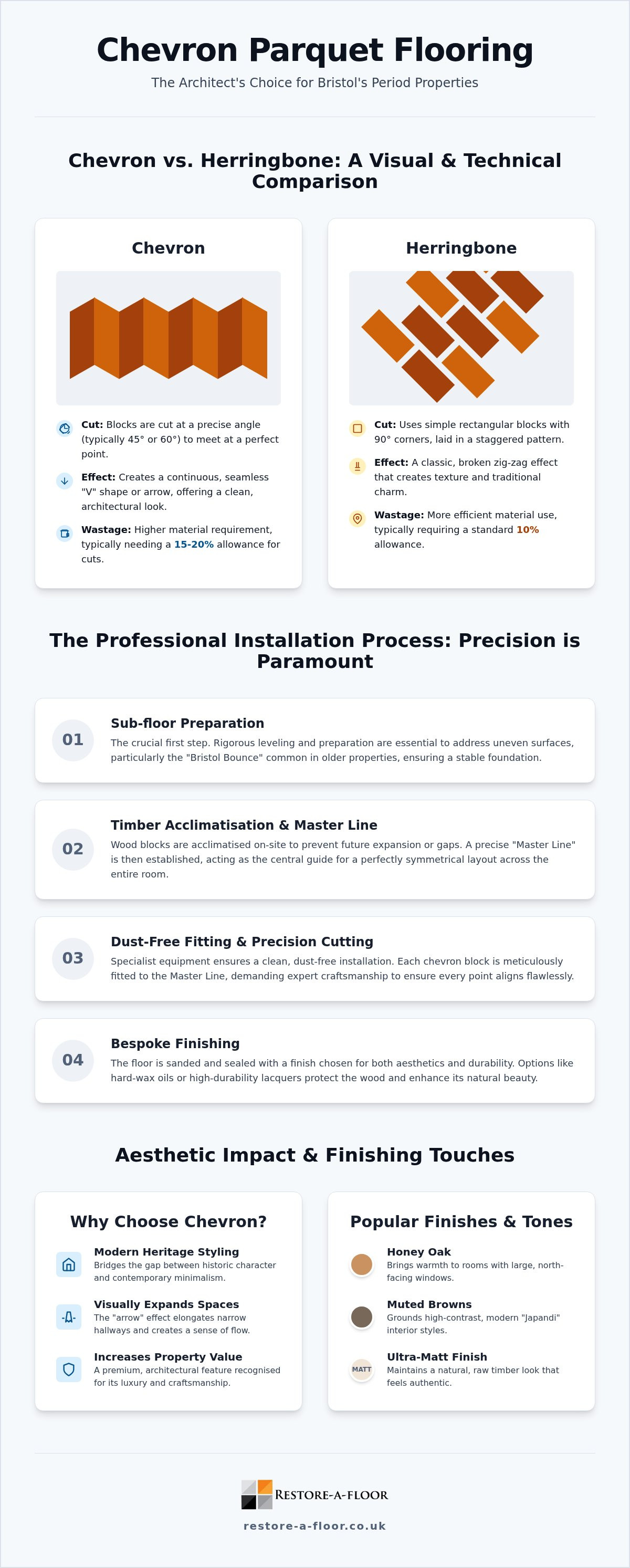
The primary difference lies in the cut. Whilst herringbone uses rectangular blocks that overlap in a staggered zig-zag, chevron blocks are cut at a precise angle, usually 45 or 60 degrees, so they meet at a perfect point. This creates a continuous, clean "V" shape that is often perceived as the more premium architectural choice. The resulting symmetry provides a calmer, more organised aesthetic than the broken lines of herringbone. It's a meticulous process that demands technical proficiency, as even a millimetre of deviation can ruin the entire alignment across a large room.
Aesthetic Impact in Period Bristol Homes
For those living in Victorian or Edwardian terraces, chevron is a powerful tool for spatial manipulation. In narrow hallways, the pattern can be used to visually elongate the space, making a cramped entrance feel significantly more expansive. There's also a unique interplay with light. Because the wood grain runs in different directions on each side of the "V", the floor blocks reflect light differently, creating a "shimmer" effect that changes as you move through the room. To honour the local palette, many are opting for:
Honey Oak: To bring warmth to rooms with large, north-facing sash windows.
Muted Browns: To ground the high-contrast "Japandi 2.0" styles popular in Southville.
Ultra-Matt Finishes: To maintain a natural, raw timber look that feels authentic to the home's history.
Chevron vs. Herringbone: A Technical and Aesthetic Comparison
Whilst both patterns fall under the umbrella of traditional parquetry, the technical distinction between them is significant. The defining characteristic of chevron is the mitre cut. Each individual block is cut at a precise angle, typically 45 or 60 degrees, allowing the ends to meet at a perfect point. This creates a continuous, unbroken "arrow" or "V" shape across the room. In contrast, herringbone uses standard rectangular blocks that overlap in a head-to-side arrangement, resulting in a staggered, broken zig-zag texture. This geometric difference isn't just visual; it fundamentally changes the requirements for chevron parquet floor installation Bristol.
Homeowners must consider the material implications of these angled cuts. Because each block requires mitring, chevron projects naturally generate more wastage than herringbone. Whilst a standard herringbone layout might require a 10% wastage allowance, a bespoke chevron installation often demands 15% to 20%. This ensures that every point aligns perfectly along the "Master Line" without compromising the timber's structural integrity. Although the initial investment in materials and labour is higher, the result is a cleaner, more architectural finish that significantly enhances the long-term market value of a property.
Visual Comparison: The Arrow vs. The Zig-Zag
The choice between these patterns often depends on the desired atmosphere. Chevron’s point-to-point joins create a sense of calm and order, making it the ideal partner for the "Modern Heritage" aesthetic. It feels more like a designed architectural feature than a traditional floor covering. Herringbone, with its overlapping blocks, offers a busier, more rhythmic texture that can feel more "rustic" or traditional. In the grand proportions of a Clifton townhouse, chevron’s linear precision provides a sophisticated counterpoint to ornate cornicing and original fireplaces.
Technical Fitting Requirements
Precision is non-negotiable when fitting chevron. The central spine of the room must be calculated with mathematical accuracy; if the first row is out by even a fraction of a degree, the error will compound across the entire floor. This pattern is also far less forgiving of sub-floor imperfections than herringbone. When installing flooring in period properties, we often find that original joists have settled unevenly. Whilst herringbone can sometimes mask minor dips, chevron will highlight them through misaligned points. This level of complexity is why many clients look to established parquet floor installation Birmingham methods to ensure their Bristol projects meet the highest professional standards.
If you're unsure which pattern best suits your home's unique layout, our team can provide expert guidance on bespoke parquet selection and fitting.
The Professional Chevron Parquet Installation Process
Successful chevron parquet floor installation Bristol relies on a combination of technical rigour and patience. It isn't a project that can be rushed. The process begins long before the first block is laid, specifically with timber acclimatisation. Bristol’s maritime climate often results in fluctuating indoor humidity levels. We ensure that the wood blocks reach a state of equilibrium with your home's specific environment. This typically involves storing the timber in the target room for at least 7 to 14 days, preventing the boards from shrinking or expanding after they've been secured.
We utilise professional-grade, silane-based adhesives to bond the blocks to the sub-floor. These adhesives are chosen for their permanent elasticity, which accommodates natural wood movement whilst providing exceptional sound dampening. Once the floor is fitted, our dust-free sanding technology becomes the focal point. This specialised equipment captures 99.9% of airborne particles, ensuring your home remains clean and the final bespoke finish is entirely free from grit or contaminants. This meticulous approach is what separates a high-end installation from a standard flooring job.
Step-by-Step: From Sub-floor to Final Seal
The foundation of every chevron project is the "Master Line". We use high-precision lasers to establish this central spine, ensuring the pattern remains perfectly symmetrical across the entire floor. If this initial line is even slightly askew, the "V" pattern will drift, becoming noticeably crooked as it reaches the walls. Once the main field is complete, we hand-finish the perimeter blocks. This tailored approach allows us to create beautiful borders that frame the room, providing a polished look that standard DIY methods simply cannot replicate.
Specialist Tools for a Flawless Finish
Achieving the iconic 45-degree angle of a chevron floor requires industrial-grade mitre saws with fine-tooth blades to prevent splintering. We don't rely on guesswork; moisture meters are used at every stage to verify that both the timber and the sub-floor are within the correct parameters. Managing transitions between rooms is another area where specialist expertise is vital. We carefully plan the pattern to ensure it flows seamlessly through doorways, maintaining the geometric integrity of the chevron throughout the property. This level of detail ensures your floor doesn't just look good today, but remains stable for decades to come.
Overcoming Bristol’s Period Property Challenges
Bristol’s architectural heritage is unparalleled, yet the city's Victorian and Georgian housing stock presents unique structural hurdles for modern flooring. The "Bristol Bounce" is a frequent issue we encounter; it's the subtle deflection in original timber joists that have settled over more than a century. For a successful chevron parquet floor installation Bristol, this movement must be neutralised. Without a perfectly rigid base, the geometric precision of the chevron pattern will eventually suffer, leading to unsightly gaps or "opening joins" at the sharp points of the "V" shape.
Addressing these historic quirks requires more than just a standard underlay. We provide comprehensive sub floor preparation services to ensure the longevity of your parquet. By focusing on the structural foundation first, we prevent the common pitfalls associated with fitting high-end timber in older environments. This methodical approach is essential for maintaining the "as-installed" look in properties that were never designed for the weight and precision of modern parquetry.
Sub-floor Levelling and Strengthening
We prioritise creating a "table-top" flat surface before any timber arrives on site. This often involves over-boarding original floorboards with high-grade plywood or applying specialised smoothing compounds to uneven concrete bases. If the original joists are compromised, we reinforce them to ensure the floor remains silent and stable underfoot. Chevron is far less forgiving than standard planks or even herringbone. If the sub-floor dips by even a few millimetres, the mitred ends will fail to meet, ruining the architectural symmetry that makes chevron so desirable.
Damp Proofing and Membrane Installation
Many Bristol residents in basement flats or ground-floor Victorian renovations face challenges with rising damp. Older masonry often lacks a modern damp-proof course, which can be catastrophic for expensive timber blocks. We use digital moisture meters to conduct thorough testing across the entire site. To protect your investment, we apply liquid Damp Proof Membranes (DPMs) that create an impermeable barrier. This prevents the wood from absorbing sub-floor moisture, which would otherwise cause the blocks to expand, cup, or lift away from the adhesive.
In converted period buildings, soundproofing is often a legal requirement or a matter of neighbourly courtesy. We integrate high-performance acoustic underlays that dampen impact noise without compromising the level of the floor. This is particularly vital in multi-occupancy townhouses in areas like Redland or Montpelier. By addressing these technical challenges head-on, we ensure your bespoke floor remains a permanent fixture of the home. If your property has complex sub-floor requirements, you can book a technical survey with our Bristol team to assess the best way forward.
Bespoke Finishes and Long-term Care for Your Chevron Floor
The final stage of a successful chevron parquet floor installation Bristol is the application of a high-performance finish. This choice defines both the aesthetic character and the maintenance requirements of your home for years to come. We generally guide clients between hard-wax oils and high-durability lacquers. Hard-wax oils are favoured for their ability to penetrate deep into the timber grain, providing a natural, "open-pore" look that's easily spot-repaired if minor scratches occur. Conversely, modern lacquers create a robust, impermeable seal that's ideal for high-traffic areas like hallways or open-plan kitchens; they offer superior resistance to liquid spills and require minimal day-to-day intervention.
A professionally installed chevron floor is an investment intended to last for 50 years or more. To maintain the "as-installed" look, we recommend a consistent maintenance schedule that avoids abrasive cleaners or excessive moisture. Whilst the wood itself is incredibly durable, the finish is what takes the brunt of daily wear. If your floor eventually begins to show signs of heavy use after a decade or more, our specialised dust-free floor sanding Swansea technology can be deployed for a future refresh. This system allows us to remove the old finish and surface imperfections without creating the mess typically associated with floor restoration, ensuring your home remains clean and healthy.
Selecting the Right Colour and Texture
The visual impact of the chevron pattern is heavily influenced by the chosen timber treatment. Smoked oaks are currently a significant trend amongst Bristol homeowners, as the smoking process reacts with the natural tannins in the wood to create deep, moody tones that look stunning in grand Clifton reception rooms. For those preferring the "Japandi 2.0" aesthetic, natural light tones or honey oaks provide a brighter, more airy feel. We also offer brushed finishes, where the softer springwood is textured to create a tactile surface that highlights the geometric "V" pattern. All our finishes are eco-friendly and non-toxic, ensuring a safe indoor environment for your family.
The Restore-A-Floor Difference in Bristol
With over 20 years of industry experience, our family-owned team understands that parquetry is as much an art as it is a technical discipline. We take immense pride in the precision of our work, ensuring that every mitre join is tight and every row is perfectly aligned with laser accuracy. This commitment to craftsmanship is why we're trusted by residents across the city to deliver bespoke, high-end results that stand the test of time. We don't just fit floors; we lead you through a technical journey to ensure your total satisfaction. Ready to transform your Bristol home? Contact Restore-A-Floor for a free chevron parquet quotation.
Elevate Your Bristol Home with Timeless Chevron Precision
Selecting chevron parquet is a definitive statement in architectural excellence that transcends standard flooring trends. We've examined how this pattern's sharp geometry complements the grand proportions of Bristol's period homes whilst requiring a level of technical mastery that only seasoned experts can provide. Success hinges on rigorous sub-floor preparation and the mathematical alignment of the Master Line to prevent the pattern from drifting over time. By prioritising professional chevron parquet floor installation Bristol, you ensure that historic structural challenges are expertly mitigated before the first timber block is laid.
With over 20 years of bespoke flooring expertise, our family-owned team focuses on dust-free installation and restoration for residents across the South West. We're here to help you navigate the nuanced choices between hard-wax oils and lacquers, ensuring your floor remains a stunning focal point for decades. Our qualified local specialists are dedicated to delivering a finish that reflects our pride in craftsmanship and your specific interior vision. It's an investment in quality that pays dividends in both aesthetic beauty and property value.
Book your free chevron parquet consultation in Bristol today to begin your home's transformation. We look forward to guiding you through a seamless, high-end installation process.
Frequently Asked Questions
How long does chevron parquet floor installation take in a standard Bristol home?
A professional installation typically requires between 7 and 14 days to complete. This timeframe includes the essential period for timber acclimatisation, which ensures the wood reaches equilibrium with your home's humidity. The actual fitting process is meticulous, as establishing the "Master Line" and executing precise mitre cuts demands significant time. Bristol period properties often require additional days for complex sub-floor levelling to guarantee a stable, long-lasting result.
Is chevron more expensive to install than standard wood planks?
Yes, chevron involves a higher initial investment than standard planks or even herringbone. The increased cost reflects the technical expertise required for chevron parquet floor installation Bristol and the labour-intensive nature of the mitre joins. Because every block is cut at an angle, the process is slower and requires higher precision. Homeowners should also account for the increased material requirements, as the geometric pattern creates more wastage than traditional layouts.
Can chevron parquet be installed over underfloor heating?
Chevron parquet is perfectly compatible with underfloor heating, provided you select engineered wood blocks rather than solid timber. Engineered wood is constructed in layers, which provides the structural stability needed to withstand temperature fluctuations without warping or cupping. This is a popular choice for modern Bristol extensions where comfort and high-end design are equally prioritised. We always ensure the heating system is commissioned correctly before the final fitting begins.
What is the best wood species for a chevron floor in a period property?
European Oak remains the premier choice for Bristol’s Victorian and Georgian homes. It offers an ideal balance of durability and traditional aesthetic appeal, with a grain pattern that beautifully highlights the chevron’s geometric "V" shape. Oak also accepts a wide range of bespoke finishes, from deep smoked tones to light, natural oils. This versatility allows us to customise the floor to match the specific architectural character and light levels of your property.
Do I need to move all my furniture out during the installation?
We require the work area to be entirely clear of furniture and floor coverings before we begin. This is vital for establishing the central spine of the pattern and ensuring our dust-free equipment can move freely across the sub-floor. Clearing the space also protects your belongings from the installation process and allows our team to maintain the high standards of cleanliness we're known for. We can provide guidance on logistical planning during your initial technical survey.
How much material wastage should I expect with a chevron pattern?
You should expect a material wastage factor of approximately 15% to 20% for a chevron project. This is significantly higher than the 10% typically allowed for standard planks because every single block must be mitred at a 45 or 60-degree angle. These precise cuts at the end of each board ensure the points meet perfectly. Whilst this increases the initial material order, it's the only way to achieve the sharp, architectural symmetry that defines the pattern.
Can you install chevron parquet on top of existing floorboards?
Installation over existing floorboards is possible, but it requires rigorous preparation to prevent future movement. We typically over-board the original planks with high-grade plywood to create a rigid, "table-top" flat surface. This process is essential in Bristol properties to neutralise the "Bristol Bounce" caused by aging joists. By creating a stable foundation, we ensure the chevron parquet floor installation Bristol remains silent and the geometric joins stay perfectly aligned for decades.
How do I clean and maintain my chevron parquet floor to prevent scratches?
Maintain your floor by using a soft-bristle broom or a vacuum cleaner specifically designed for hard surfaces. You should only use pH-neutral wood cleaners and avoid saturated mops, as excessive water can damage the timber over time. We recommend placing protective felt pads under all furniture legs and using rugs in high-traffic entryways to trap grit. These simple steps preserve the bespoke finish and ensure the wood grain remains clear and vibrant amongst daily wear.


Comments