

Limestone Floor Cleaning Bristol: The Definitive Homeowner Care Checklist (2026)
The multi-surface cleaner sitting in your utility cupboard is quietly dissolving your limestone floor. While natural stone brings timeless architectural character to Clifton townhouses and contemporary suburban residences alike, its porous, calcium carbonate structure makes it exceptionally delicate. When tackling limestone floor cleaning Bristol homeowners frequently discover that standard off-the-shelf detergents leave cloudy chemical residues, strip protective barriers, and allow the region's notoriously hard water to bake chalky deposits directly into the stone.
It's genuinely frustrating to watch pale grout lines absorb dirty mop water, or to panic every time a splash of wine hits the surface. You shouldn't have to walk on eggshells across your own living space. This definitive checklist gives you the exact maintenance protocols required to protect your investment. You'll master straightforward daily cleaning routines using stone-safe chemistry, learn practical techniques to prevent irreversible acid etching, and discover the clear diagnostic signs that indicate when professional mechanical restoration is needed to revive tired stone.
Table of Contents
Understanding Limestone: Why Bristol Floors Require Specialist Care
The Homeowner Limestone Care Checklist: Daily and Weekly Routines
Troubleshooting Common Limestone Faults: Etches, Stains, and Grout
Professional Deep Cleaning vs Home Care: Choosing the Right Level
Selecting a Specialist for Limestone Floor Cleaning in Bristol
Understanding Limestone: Why Bristol Floors Require Specialist Care
Whether laid across the ground floors of historic Clifton townhouses or installed as broad slabs in modern Bishopston kitchen extensions, natural stone delivers an architectural warmth that artificial tiles cannot emulate. Maintaining this material, however, demands an appreciation of its physical vulnerability. When approaching limestone floor cleaning Bristol property owners quickly discover that treating sedimentary rock like hard ceramic or porcelain inevitably leads to dulling and surface degradation.
The Porous Anatomy of Calcite-Based Natural Stone
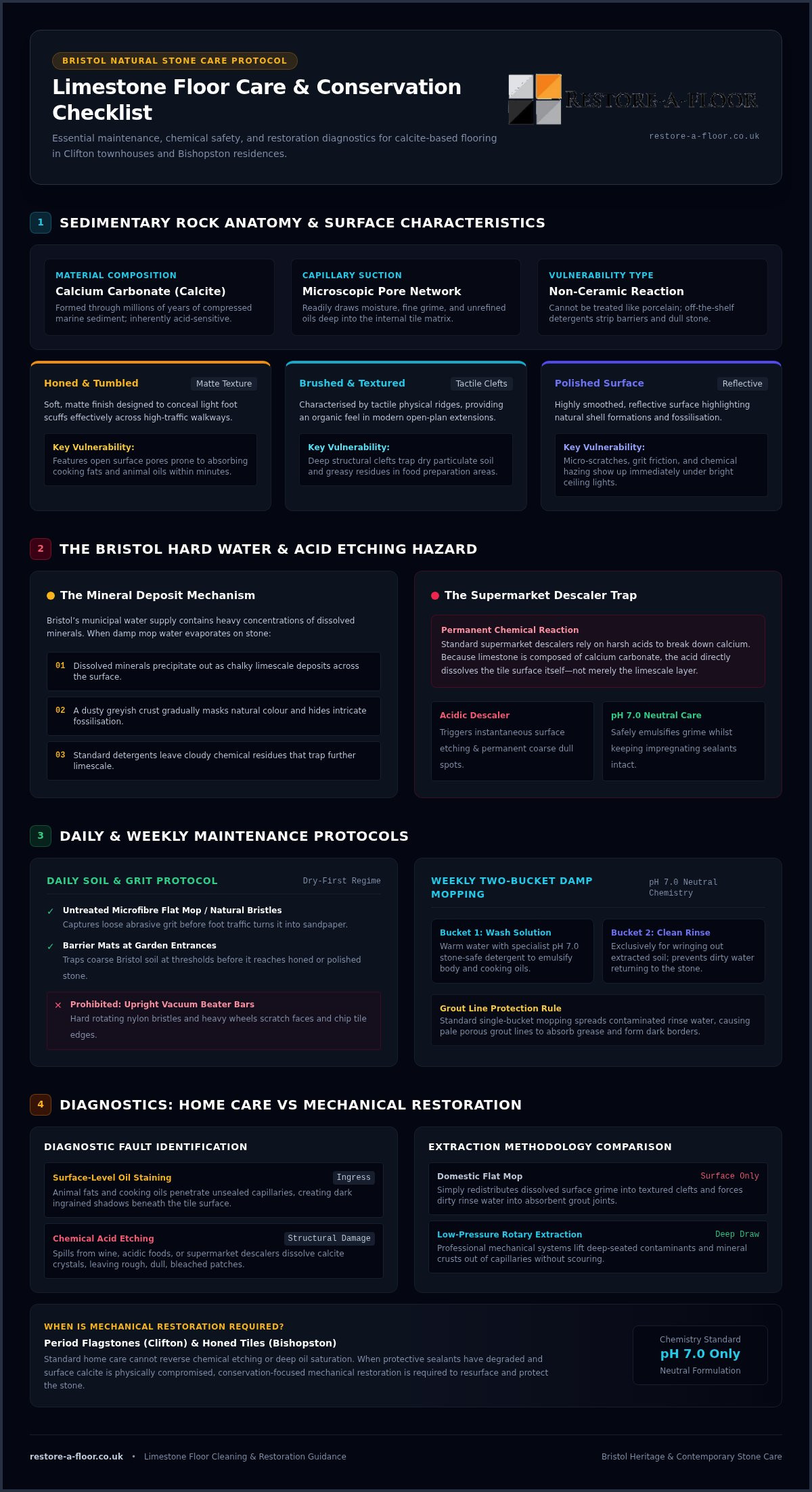
A core element of understanding limestone is recognising its calcium-rich structure. Technically defined, limestone porosity refers to the internal network of microscopic capillaries formed during millions of years of marine sediment compaction. These tiny pathways readily draw moisture, unrefined grime, and organic oils deep into the tile matrix through capillary suction. How a floor reacts to daily wear depends substantially on its surface treatment:
Honed and Tumbled: Soft, matte finishes that hide light foot scuffs well, yet feature open surface pores prone to absorbing cooking fats.
Brushed and Textured: Highly tactile clefts that collect dry particulate soil and greasy residues in busy food preparation zones.
Polished: Smooth surfaces where surface scratches and chemical hazing show up immediately under bright ceiling lights.
In busy culinary areas, animal fats and vegetable oils break past unprotected top layers in minutes, causing dark, ingrained shadows that cannot be lifted with a standard mop.
The Damaging Impact of Bristol Hard Water on Tile Surfaces
Local geography adds an extra complication. Bristol's municipal water contains heavy concentrations of dissolved minerals, which precipitate as chalky limescale deposits whenever damp mop water dries on the floor. This gradual mineral buildup clouds the stone's natural colour and hides its unique fossilisation beneath a dusty, greyish film.
The real danger arises when homeowners attempt to clear this dull crust with everyday bathroom or kitchen descalers. Standard supermarket descaling products depend on harsh acids to break down calcium deposits. Because limestone is composed of calcium carbonate, applying an acidic descaler triggers an immediate chemical reaction; the solution dissolves the actual tile surface rather than just the mineral film. This leaves behind permanent, coarse chemical etches. Preserving your investment requires tailored limestone floor cleaning Bristol techniques built on neutral chemistry and measured, mechanical lifting.
The Homeowner Limestone Care Checklist: Daily and Weekly Routines
A disciplined maintenance routine protects honed and polished stone from premature wear. Fine outdoor grit acts like coarse sandpaper under foot traffic, grinding away protective sealants and scratching tile faces. Establishing proactive care keeps your surfaces pristine between professional maintenance cycles.
Daily Dry Soil and Grit Removal Protocol
Dry extraction must always precede any wet cleaning. Sweeping with an untreated microfibre flat mop or a soft, natural-bristle broom captures loose debris before it can grind into the stone. Never use upright vacuum cleaners fitted with rotating beater bars, as hard nylon bristles and heavy plastic wheels will scratch delicate surfaces and chip tile edges. In busy family households, placing robust barrier mats at garden access points traps coarse Bristol soil before it ever crosses your threshold.
Weekly Damp Mopping with pH-Neutral Cleaners
When washing the floor, water alone cannot emulsify body oils or cooking residues, while typical floor soaps leave behind gummy layers that attract fresh grime. Instead, mix a specialist pH 7.0 detergent in warm water in line with the Natural Stone Institute care guide to preserve impregnating sealants.
The two-bucket mopping method isolates extracted soil by using one container for clean detergent wash solution and a secondary vessel exclusively for wringing out contaminated rinse water. This prevents dark, dirty water from pooling across porous grout joints. After cleaning with a wrung-out flat microfibre mop, buff the surface dry with clean lint-free towels to prevent watermarks.
Household Substances and Tools to Strictly Ban
Certain standard household staples cause catastrophic damage to natural stone floors within seconds. Keep the following products far away from your living spaces:
Kitchen Acids: White vinegar, lemon juice, wine, and citric cleaners rapidly dissolve calcite stone, leaving permanent, chalky etch circles.
Alkaline Bleaches: Thick bleach and standard bathroom sprays degrade subterranean sealer molecules, leaving the floor vulnerable to deep staining.
Steam Mops: High-pressure steam drives heat and moisture deep past protective barriers, causing spalling, hairline fractures, and sealer delamination.
Abrasive Tools: Green scouring pads and wire wool scuff honed finishes and create dull patches across polished tiles.
If your tiles have lost their lustre after years of improper products, scheduling dedicated tiled floor restoration and cleaning will reset the stone and safely re-establish its original factory finish. Routine limestone floor cleaning Bristol protocols can then keep the restored stone looking exceptional for years to come.
Troubleshooting Common Limestone Faults: Etches, Stains, and Grout
Accidents happen in active homes. Even with disciplined daily maintenance, unexpected spillages or soil migration can produce blemishes across natural stone surfaces. Successfully correcting these issues depends entirely on accurate diagnosis, as treating an acid etch like an oil stain will only spread damage across the tile.
Identifying and Rectifying Chemical Etch Marks
Chemical etching is physical surface erosion, not a topical stain. To diagnose it, crouch down and inspect the blemished area under angled natural light. If you see a dull, milky ring that feels slightly rougher than the surrounding tile, acidic liquids such as salad dressing, fruit juice, or wine have dissolved the calcite matrix.
Minor surface hazing on polished limestone can occasionally be blended using specialist marble and stone polishing compounds rubbed in with a felt pad. Deep chemical burns that bite into honed stone, however, require mechanical diamond honing. Rotating diamond abrasive discs grind past the damaged layer, re-levelling the stone face to uniform smoothness.
Formulating and Applying Stone Poultices for Oil Stains
Dark, shadowy patches around cooking hobs or dining tables indicate organic lipids that have penetrated the microscopic capillaries of unsealed stone. Washing these marks with water-based cleaners will fail because water cannot dissolve sub-surface greases. A chemical poultice acts as a reverse wick to pull the fat back out:
Mix the medium: Combine food-grade diatomaceous earth or bicarbonate of soda with pure mineral spirits to form a paste with the consistency of peanut butter.
Apply the pack: Spread a six-millimetre layer directly over the stain, overlapping the dry edges by roughly a centimetre.
Tape and wait: Cover the area with clingfilm, puncture a few pinholes for ventilation, and seal the edges with low-tack masking tape for twenty-four to forty-eight hours.
Extract: Gently lift away the dried powder using a flexible plastic spatula, then wash the spot with clean water.
Revitalising Deep Grout Lines Safely
Discoloured grout lines develop when mop heads deposit suspended soil into the porous, cementitious recesses between tiles. Over months of routine limestone floor cleaning Bristol homeowners often notice grout turning greasy and dark.
To lift this grime safely, spray an oxygenated, alkaline grout cleaner directly along the channels and let it dwell for ten minutes. Work the solution into the joint using a stiff nylon-bristle detail brush; never use brass or steel wire brushes, which scratch soft limestone edges immediately. Extract the dislodged suspension using a wet vacuum, then flood-rinse with fresh water to prevent dirty residues from settling straight back into the cement matrix.
Professional Deep Cleaning vs Home Care: Choosing the Right Level
Routine domestic maintenance preserves everyday hygiene, but mop buckets and microfibre pads cannot reverse physical mineral abrasion or years of chemical degradation. When evaluating limestone floor cleaning Bristol homeowners often reach a turning point where superficial washing must give way to mechanical stone engineering to revive dull, compacted surfaces.
Mechanical Rotary Cleaning and Low-Pressure Slurry Extraction
Contra-rotating industrial scrubbers deliver agitation that domestic tools simply cannot match. Heavy-duty cylindrical brushes rotate across opposing axes, penetrating the deepest clefts of tumbled flagstones to dislodge compacted grime. Simultaneously, continuous low-pressure slurry extraction systems lift emulsified contaminants off the floor instantly. This prevents dirty fluid from saturating underlying timber joists or subfloors. For regional project insights, explore our sibling guide on tiled floor restoration Cardiff.
Diamond Honing and Planetary Polishing Systems
When stone faces suffer from scratch patterns, lippage, or deep acid burns, chemical cleaning alone falls short. Diamond resurfacing uses industrial planetary machinery fitted with diamond-impregnated resin discs to physically grind away damaged calcite layers. Stepping progressively through grits from coarse forty-grit up to fine three-thousand-grit restores optical clarity to your chosen sheen, whether soft matte, contemporary satin, or reflective gloss. Because this mechanical sequence is water-lubricated, domestic living spaces remain entirely dust-free throughout the process.
Selecting Penetrating Impregnators versus Topical Sealers
The decisive phase of stone restoration lies in protective sealing. Inexperienced operators often apply cheap topical acrylic lacquers that sit across the tile surface to create artificial shine. Over time, these surface coatings peel, scratch, and yellow under ultraviolet light.
Specialist care demands breathable penetrating impregnators. These treatments sink below the surface, chemically altering pore tension without blocking natural vapour transmission. This breathability is essential for period architecture built over lime beds or suspended subfloors, where trapped moisture would otherwise cause spalling. If your natural stone shows signs of ingrained wear, book a professional tiled floor restoration and cleaning consultation to inspect your floor's structural condition.
Selecting a Specialist for Limestone Floor Cleaning in Bristol
Selecting a stone restorer in the Bristol area requires careful evaluation. Period properties across Leigh Woods, Clifton, and Redland feature structural idiosyncrasies that general cleaning outfits often misjudge. Natural stone is an architectural asset; entrusting it to contractors who treat it like resilient ceramic risks deep water saturation, blown grout, or permanent chemical etching.
Surveying Period Townhouses and Contemporary Architectural Spaces
A rigorous pre-clean assessment separates genuine stone conservators from quick-fix cleaners. Before initiating any limestone floor cleaning Bristol specialists must perform an in-depth survey inspecting stone density, damp movement, and subfloor stability. In older Georgian ground floors and Victorian extensions, flagstones often rest on traditional lime beds or suspended timber rather than concrete slabs with modern damp-proof membranes. Understanding how these substrates breathe prevents moisture from becoming trapped beneath the tiles.
Surveys also uncover historic layers of yellowed acrylic wax or floor polishes that require controlled chemical stripping before mechanical honing can begin. Technicians should always conduct discreet test patches in low-visibility corners. This step verifies chemical neutrality, establishes exact dwell times, and confirms the final honed or polished sheen matches your expectations.
The Restore-A-Floor Commitment: 20 Years of Craftsmanship
With over 20 years of specialist industry experience across the South West, Restore-A-Floor provides project-based expertise tailored to delicate sedimentary surfaces. Our technicians operate full-service dust-free systems, using wet-mechanical processes that safeguard historic cornicing, bespoke cabinetry, and adjacent timber flooring from airborne dust or abrasive slurry.
We don't offer generic, superficial washes. Instead, we engineer tailored treatments for historic flagstones, honed tiles, and modern polished surfaces to preserve domestic interiors for decades to come. Every restoration concludes with a thorough post-treatment handover, providing you with the exact routines and stone-safe chemistry required to maintain your investment. To assess your property and explore conservation-grade options, arrange a comprehensive site survey with Restore-A-Floor specialist technicians.
Restoring Long-Term Vitality to Your Natural Stone
Protecting limestone requires respecting its unique geology. By establishing a dry-first cleaning discipline, avoiding caustic supermarket chemicals, and isolating dirty wash water, you prevent premature surface degradation and preserve your stone's organic character. Routine care shields your investment against everyday spills, yet years of heavy foot traffic and hard mineral deposits eventually demand deeper intervention.
When daily maintenance no longer lifts entrenched soils or dull etch patterns, mechanical diamond honing and breathable impregnation can safely reset your floor to factory standards. Backed by over 20 years of bespoke stone and floor restoration expertise across Bristol, Cardiff, and Swansea, our technicians use clean, dust-free methodology to protect fine domestic interiors throughout every project. Rather than risking permanent etching through trial and error, discover how dedicated limestone floor cleaning Bristol protocols can revive your living space. Revitalise your natural stone with Restore-A-Floor specialist restoration and enjoy pristine, enduring surfaces for decades to come.
Frequently Asked Questions
Can I use white vinegar or lemon juice to clean limescale off limestone?
Absolutely not; applying acidic liquids like white vinegar or lemon juice will instantly etch and corrode limestone. Because limestone is formed from calcium carbonate, acid chemically reacts with the stone, dissolving the delicate surface within seconds. This leaves rough, chalky scars that no amount of washing can wipe away. Always use dedicated pH-neutral stone detergents, and rely on mechanical honing to safely lift stubborn mineral deposits.
How often should a natural limestone floor be professionally sealed?
Most domestic limestone floors require professional resealing every two to three years, depending on traffic volume and room placement. High-traffic areas like busy family kitchens and hallways wear down protective impregnators much faster than formal dining rooms. You can test your protection by placing a few water droplets on the tile for ten minutes; if the stone darkens, moisture is penetrating and resealing is necessary.
What causes white, cloudy patches to form on my limestone tiles?
White, cloudy patches typically stem from dried hard water mineral scale, efflorescence from damp subfloors, or unrinsed detergent residue. In Bristol, mineral-heavy mains water frequently leaves calcium salts across stone tiles as damp mop water dries. When carrying out limestone floor cleaning Bristol technicians evaluate whether the issue is topical residue from unsuitable floor cleaners or deeper ground moisture migrating upward through older lime-bed subfloors.
Can scratches and acid etches be removed from honed limestone floors?
Yes, scratches and chemical acid etches can be completely erased using mechanical diamond honing. Because etching is physical stone loss rather than a surface stain, washing alone won't restore the blemish. Restorers operate rotary machinery fitted with diamond-impregnated resin discs to shave away damaged layers and re-level the tile face. This process blends the damaged area seamlessly into the surrounding stone to restore a uniform finish.
Is professional limestone floor cleaning completely dust-free?
Yes, specialist stone honing, deep cleaning, and polishing is a clean, water-lubricated process that creates zero airborne dust. Technicians operate water-fed rotary equipment paired with continuous low-pressure slurry extraction systems. The lubricating water encapsulates loosened mineral particles instantly into a manageable suspension, which is immediately vacuumed away. This ensures your home's air remains clean, safeguarding adjacent furnishings, fitted cabinetry, and historic plasterwork throughout the restoration.
What is the best daily mop to use on delicate natural stone?
A flat microfibre mop fitted with an untreated, washable microfibre pad is the safest tool for everyday natural stone care. Traditional cotton string mops slosh dirty water across broad areas and push muddy slurry directly into porous cement grout lines. Flat microfibre pads glide effortlessly over honed tiles, trapping abrasive dry grit without scratching. They keep surfaces clean without requiring excessive water or aggressive chemical additives.
How long does a professional limestone deep clean and reseal take?
A comprehensive deep clean, diamond hone, and reseal typically takes between one and two days for an average domestic space. When scheduling limestone floor cleaning Bristol homeowners should factor in adequate drying intervals alongside mechanical work. Rotary extraction and scratch removal usually conclude on day one. The stone must then dry fully before breathable impregnating sealants are applied and cured for foot traffic.


Comments