

Victorian Floor Tile Restoration Bristol: Expert Restoration for Period Properties
- info089907
- 11 minutes ago
- 12 min read
Your original Victorian hallway isn't just a floor; it's a piece of Bristol's architectural identity that often lies forgotten beneath decades of grime and old adhesive. Many homeowners across the city feel a sense of despair when they peel back worn carpets only to find cracked geometric tiles and stubborn staining that seems impossible to shift. It's understandably frustrating to see such historic beauty dimmed by years of neglect and poor maintenance. Our professional Victorian floor tile restoration Bristol service is designed to breathe life back into these intricate patterns, ensuring your home's entrance becomes a vibrant, historically accurate focal point once again.
We'll show you how we utilise dust-free technology and specialist tile-matching techniques to transform dull, damaged surfaces into durable, easy-to-clean masterpieces that respect the heritage of your period property. This article explores our meticulous process for reviving original features, drawing on over 20 years of expertise to ensure your floor is handled with the care it deserves. You'll discover how a tailored restoration approach can preserve your home's character whilst adding significant aesthetic and functional value to your living space. From navigating heritage conservation standards to achieving a flawless, hand-crafted finish, we provide the expert guidance needed to restore your floor to its former glory.
Table of Contents
The Architectural Heritage of Victorian Tiled Floors in Bristol
Bristol’s architectural identity is defined by its stunning Victorian and Edwardian terraces. In neighbourhoods like Clifton, Redland, and Cotham, these properties often retain original features that serve as a testament to 19th-century craftsmanship. Victorian hallways were never merely functional; they were designed as a deliberate statement of status, blending aesthetic grandeur with a historical obsession with hygiene. Unlike porous stone or timber, these unglazed clay tiles provided a durable, washable surface that could be easily sanitised. Today, Victorian floor tile restoration Bristol is a vital service for homeowners looking to reclaim this lost elegance from beneath layers of modern floor coverings.
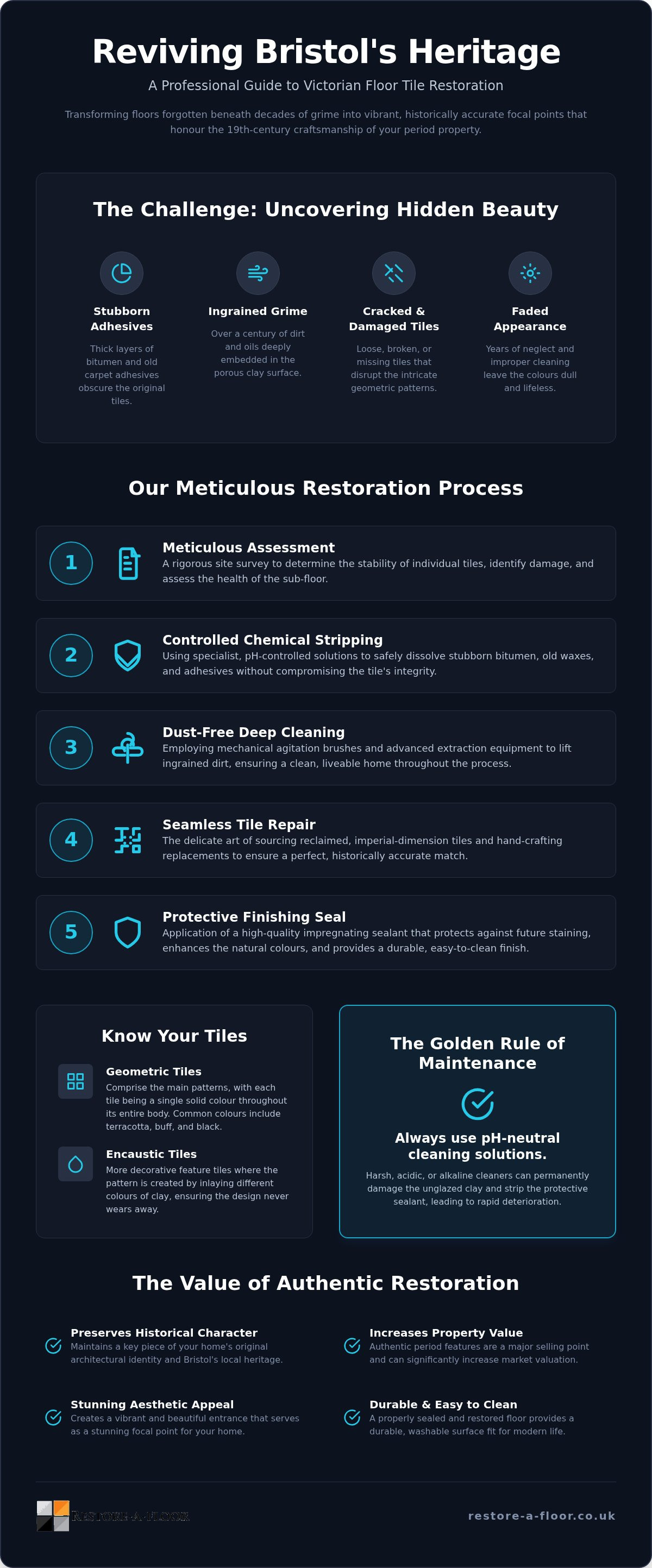
The composition of these floors typically involves hundreds of small, individually fired geometric tiles. They are arranged in complex, repeating patterns that draw the eye through the property’s entrance. Whilst standard geometric tiles are a single solid colour throughout, more prestigious homes often feature Encaustic tiles. These are particularly special because the patterns are created by inlaying different colours of clay, rather than simply painting the surface. This ensures the design remains visible even after a century of foot traffic.
Identifying Original Minton and Encaustic Tiles
Distinguishing between the various types of period tiling is essential for a successful restoration. Most Bristol townhouses feature a palette of earthy tones, specifically terracotta, buff, and black. These colours were chosen for their durability and ability to hide the soot and grime of a coal-heated city. You’ll often find these floors hidden under old carpet adhesives or thick bitumen. This was a common practice in the mid-20th century when homeowners favoured "modern" materials over traditional designs. Removing these residues requires a meticulous approach to ensure the delicate clay surface isn't damaged during the process.
The Value of Preservation for Bristol Homeowners
Restoring an original floor is a strategic investment in your property’s future. In the competitive North Bristol housing market, original features are a major selling point for prospective buyers who value authenticity over modern imitations. Replacing a damaged Victorian floor with contemporary porcelain or LVT might seem convenient, but it results in a permanent loss of character and historical value. It's a heritage asset.
When you choose professional Victorian floor tile restoration Bristol, you're choosing to preserve a piece of local history. For those interested in the broader regional context, our guide to tiled floor restoration Cardiff highlights similar heritage patterns across the South West and Wales. Properly restored tiles don't just look better; they significantly increase the "kerb appeal" and overall market valuation of your home. It's a hallmark of quality.
The Professional Process of Victorian Floor Tile Restoration
Restoration begins with a rigorous site survey to determine the stability of individual tiles and the health of the sub-floor. This isn't a superficial wash; it's a technical intervention. Professional Victorian floor tile restoration Bristol requires identifying precisely what lies beneath the surface, such as bitumen from old floor coverings or deep-seated oils that have accumulated over a century. We use controlled chemical stripping to dissolve these residues without compromising the tile's integrity. It's a delicate balance of chemistry and patience.
Following stripping, we employ deep mechanical cleaning. This involves specialist agitation brushes and pH-neutral solutions that lift ingrained dirt from the microscopic pores of the clay. Because these floors are usually located in central hallways, we prioritise a dust-free environment. Our advanced extraction equipment ensures your home remains clean and liveable throughout the project, avoiding the mess typically associated with floor work. For more technical details on these standards, you can refer to guidance on Preserving Historic Ceramic Tile Floors.
Sub-Floor Preparation and Stabilisation
Many Bristol properties suffer from loose or "hollow" sounding tiles, often caused by the natural degradation of original lime-based screeds. Efflorescence is the migration of salts to the tile surface. We address these structural concerns by re-fixing loose elements and ensuring the sub-floor is perfectly dry and stable before any further work proceeds. This stability is the foundation of a long-lasting finish, preventing future movement or cracking in the intricate geometric patterns.
The Art of Professional Sealing
Once the floor is pristine and dry, we apply a specialist sealer to protect the porous clay. You can choose between breathable impregnating sealers, which sit below the surface, or traditional topical finishes that offer a slight sheen. These sealants enhance the natural vibrancy of the terracotta and buff tones without creating a slippery surface. Proper sealing makes the floor resistant to modern spills and the abrasive grit common in city entrances. If you're ready to see your hallway transformed, our team at Restore-A-Floor can guide you through the best finish for your specific property.
Salvaging Damaged Tiles: When to Repair and When to Replace
Not every damaged tile requires replacement. Surface-level "pitting" or minor wear often contributes to the floor's historic narrative and doesn't compromise structural integrity. However, deep structural cracks or "ghosting", where missing tiles have been crudely patched with concrete, require professional intervention. When undertaking Victorian floor tile restoration Bristol, we evaluate each tile to determine if it can be salvaged or if a replacement is necessary for the floor's longevity. Restoration is almost always more cost-effective than a total replacement, as it avoids the substantial expense of removing the original sub-floor and installing a modern alternative that lacks the same character. It's a matter of preserving the soul of the property whilst ensuring a flat, safe walking surface.
Sourcing Historically Accurate Replacement Tiles
Finding a perfect match is often the most challenging aspect of a project. 19th-century tiles were manufactured to imperial dimensions, which do not align with modern metric standards. We work closely with specialist reclaimed suppliers to source authentic pieces that match the original thickness, shade, and geometric shape. Precision is paramount; we often hand-cut tiles to fit the unique eccentricities of an original pattern. Even the grout colour is carefully selected to match the aged appearance of the existing floor, ensuring that the repair is virtually indistinguishable from the surrounding area. This bespoke approach ensures the geometric symmetry remains unbroken.
Repairing Cracks and Missing Grout
Period properties in Bristol are prone to subtle structural movement, which can cause traditional rigid grouts to fail over time. We utilise flexible, breathable grouts that accommodate this movement without cracking or crumbling. Removing a single damaged tile is a surgical process. We carefully rake out the surrounding grout to extract the piece without disturbing the delicate bond of neighbouring tiles. This level of precision is what separates a DIY attempt from a professional finish.
For those managing different materials in their home, our guide on stone floor deep cleaning Swansea offers further insights into the complexities of repairing and maintaining natural surfaces. By addressing minor failures and missing grout early, we prevent moisture ingress and further tile loss. This proactive management secures the floor for another century of use, maintaining both the aesthetic appeal and the structural health of your hallway entrance.
Preserving the Finish: Maintenance for Restored Victorian Hallways
Once the meticulous process of Victorian floor tile restoration Bristol is complete, the focus shifts to long-term preservation. This is an investment that requires specific, informed care to maintain its 19th-century lustre and structural integrity. The "Golden Rule" of period tile maintenance is the absolute avoidance of acidic, citrus-based, or bleach-heavy cleaners. These harsh household chemicals strip away the protective professional sealer and can cause irreversible chemical etching on the delicate clay surface. Instead, it's best to use pH-neutral soaps specifically formulated for unglazed tiles. These solutions effectively lift surface contaminants without compromising the protective barrier we've applied.
Entrance management is your first line of defence. Bristol's damp climate often brings abrasive grit and moisture into the hallway, which acts like sandpaper underfoot. We strongly recommend implementing a "no-shoes" policy or installing high-quality, heavy-duty grit-capture mats at all external doorways. This simple habit prevents the microscopic scratching that eventually leads to a dull, faded appearance. When you invest in professional Victorian floor tile restoration Bristol, a structured maintenance plan is the best way to ensure those results last for decades.
Daily and Weekly Cleaning Routines
Routine maintenance should always prioritise dry methods over wet ones. Frequent dry sweeping or vacuuming with a soft brush attachment is far more beneficial for geometric tiles than traditional mopping. Excessive water is a significant risk; many original floors in Bristol were laid without a modern damp-proof course. "Over-wetting" can trap moisture within the sub-floor, potentially leading to salt migration or the weakening of the original lime mortar. When mopping is necessary, use a microfibre flat-mop that is barely damp to the touch, ensuring the surface dries almost instantly.
Protecting Your Investment Long-Term
Even with impeccable daily care, professional sealers will eventually wear thin in high-traffic zones, such as the area immediately behind the front door. You can identify this wear when the tiles begin to look "thirsty" or when water no longer beads on the surface. For a standard residential hallway in Bristol, we suggest a professional "top-up" clean and reseal every three to five years to maintain the vibrancy of the colours. It's crucial to avoid "supermarket waxes" or "self-shining" floor polishes. These products typically contain cheap acrylics that yellow over time and eventually peel, creating a patchy, unsightly residue that requires professional stripping to rectify. If you notice your floor is losing its depth of colour, reach out to the experts at Restore-A-Floor to discuss a maintenance schedule that suits your home.
Why Restore-A-Floor is the Trusted Choice for Bristol Period Properties
Choosing the right partner for Victorian floor tile restoration Bristol is a decision that impacts the long-term value and aesthetic integrity of your home. We've spent over 20 years refining our craft, operating as a family-owned specialist under Turrell Family Properties LTD. This heritage isn't just about time; it's about a deep-seated commitment to precision and the preservation of Bristol's unique architectural fabric. We understand that a residential hallway is a high-traffic environment, which is why our bespoke solutions are tailored to the specific needs of each property, whether it's a grand townhouse or a modest terrace. Our experience ensures that every tile is handled with the technical proficiency required for heritage assets.
Our primary differentiator is our commitment to a dust-free process. Many traditional restoration methods create a significant amount of airborne debris that can settle throughout your home, causing disruption and requiring extensive cleaning. We utilise advanced refinishing technology that captures particles at the source, ensuring your living space remains clean and healthy whilst we work. It's this focus on modern technology combined with traditional hand-crafted techniques that allows us to deliver superior results without the mess. We don't just clean; we manage the entire environment to protect your property's interior.
Our Local Expertise Across Bristol
Our portfolio spans the entire city, from the expansive grand villas of Clifton to the charming terraced homes of Bishopston and Southville. We've encountered almost every variation of geometric pattern and sub-floor challenge common to the region. This local knowledge allows us to anticipate issues before they arise, providing a seamless experience for our clients. For homeowners looking to contrast their period features with contemporary finishes, our guide to polished concrete floor Bristol explores how modern materials can complement historic architecture. We take immense pride in respecting the city's historic fabric with every project we undertake.
The Restore-A-Floor Service Guarantee
We believe that professional Victorian floor tile restoration Bristol should be transparent and stress-free. Our team organises every stage of the journey, from the initial site survey to the final application of breathable sealants. We provide fixed-quote pricing, ensuring there are no hidden surprises or unexpected costs once the project commences. This straightforward approach is designed to instill confidence and provide peace of mind. If you're ready to revive the historic charm of your flooring, we invite you to request a free, no-obligation quotation for your Bristol project today. Let us help you transform your hallway into the statement entrance it was always meant to be.
Revitalising Your Home’s Historic Grandeur
Restoring a period floor is more than a simple cleaning task; it's a meticulous act of preservation that secures a piece of Bristol’s architectural history. We’ve explored how identifying original patterns and implementing a technical, dust-free restoration process can transform a neglected hallway into a vibrant statement entrance. By prioritising pH-neutral maintenance and addressing structural repairs with historically accurate materials, you ensure your floor remains a durable asset for the next generation.
As family-owned experts with over 20 years of experience, we pride ourselves on delivering bespoke results that respect the unique character of your property. Our specialist Victorian floor tile restoration Bristol service combines traditional craftsmanship with modern technology to provide a seamless, high-end finish. Whether you’re uncovering a hidden gem or maintaining a cherished original feature, professional intervention is the key to lasting quality and aesthetic precision.
Request your free, no-obligation Victorian tile restoration quote today and take the first step toward reclaiming your home’s original charm. We look forward to helping you reveal the true potential of your historic flooring and ensuring it remains a standout feature of your Bristol home for years to come.
Frequently Asked Questions
How long does it take to restore a Victorian tiled hallway in Bristol?
A standard residential hallway usually takes between two and four working days to complete. Our Victorian floor tile restoration Bristol process involves deep cleaning and stripping, followed by a mandatory drying period of at least 24 hours to ensure the sub-floor is moisture-free. Once stable, we apply multiple coats of specialist sealer. Larger projects with extensive tile replacement or complex patterns may require additional time for hand-cutting and precise placement.
Can you remove bitumen or carpet glue from Victorian tiles?
We can successfully remove stubborn bitumen and old carpet adhesives using controlled chemical stripping agents. These residues were common in the mid-20th century but require specialist handling to avoid damaging the porous clay tiles underneath. Our process dissolves the bond of the adhesive, allowing it to be safely extracted. It's a meticulous task that requires patience to ensure no staining remains on the vibrant geometric patterns of your floor.
Will the restoration process create a lot of dust in my home?
No, our restoration process is designed to be virtually dust-free. We use advanced extraction technology and wet-cleaning methods that prevent fine particles from becoming airborne. This is a significant advantage for residential hallways, as it ensures your home remains clean and liveable throughout the project. Unlike traditional sanding or dry-scraping methods, our equipment captures debris at the source, protecting your furniture and air quality from unwanted contaminants.
Do I need to replace the whole floor if some tiles are missing?
You don't need a full replacement if tiles are missing or cracked. We specialise in sourcing reclaimed tiles or high-quality modern reproductions that match the original imperial dimensions and colours. By carefully hand-cutting these replacements to fit your specific pattern, we can restore the floor's symmetry without losing its historic character. This targeted repair approach is far more cost-effective and preserves the heritage value of your Bristol property entrance.
How much does Victorian floor tile restoration cost in Bristol?
The cost of Victorian floor tile restoration Bristol is determined by several project-specific factors rather than a flat rate. Variables such as the extent of bitumen removal, the number of individual tile replacements required, and the current stability of the sub-floor all influence the final investment. We provide transparent, fixed-quote pricing following a comprehensive site survey. This ensures you receive a bespoke assessment that reflects the unique requirements and condition of your period property's entrance.
Is it possible to restore a floor that has no damp-proof course?
It's entirely possible to restore floors without a modern damp-proof course (DPC), provided the correct materials are used. We apply breathable, impregnating sealers that allow moisture vapour to pass through the tiles rather than trapping it underneath. This prevents common issues like salt efflorescence or tile lifting. Using the wrong film-forming sealer on an old floor can cause long-term damage, so a breathable approach is essential for successful period property preservation.
What is the difference between geometric and encaustic tiles?
Geometric tiles are small, solid-coloured shapes like triangles and squares arranged in patterns. Encaustic tiles are more decorative, featuring intricate designs created by inlaying different colours of clay deep into the tile's body. This means the pattern isn't just on the surface; it runs through the tile and won't wear off over time. Most Bristol hallways feature a mix of both, with encaustic tiles often used as central focal points or borders.
How do I know if my floor is salvageable?
Most Victorian floors are salvageable, even if they look beyond repair at first glance. We look for the integrity of the sub-floor and the percentage of original tiles remaining. Even floors with significant ghosting or concrete patches can be restored by sourcing matching replacements. If the majority of the tiles are still firmly bonded to the screed, a professional deep clean and reseal can achieve a truly transformative and historically accurate result.


Comments