

Victorian Floorboard Restoration in Swansea
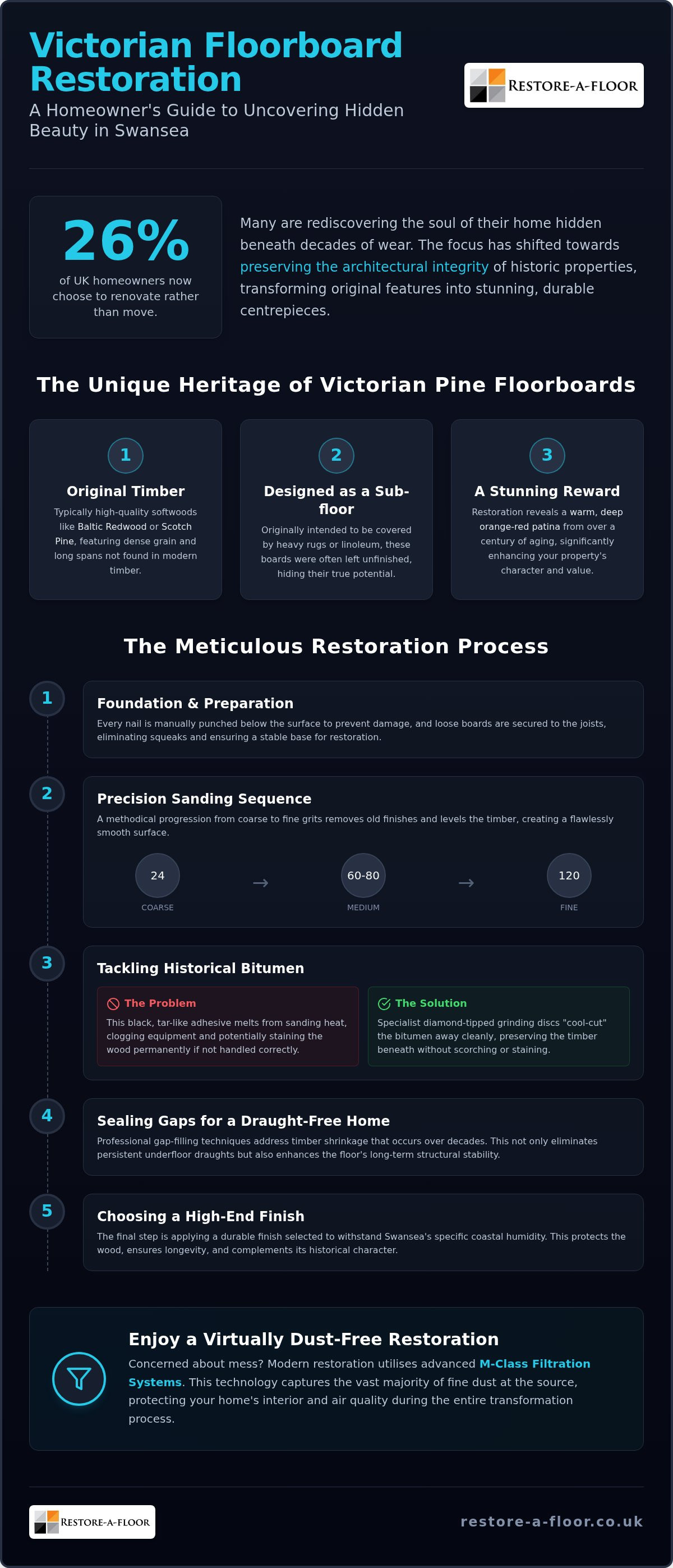
What if the true soul of your home isn't found in a showroom, but lies hidden beneath decades of wear and stubborn black bitumen? With over 26% of UK homeowners now choosing to renovate rather than move, the focus has shifted toward preserving the architectural integrity of our historic properties. You probably value the unique charm of your period home, yet you're likely concerned that Victorian floorboard restoration Swansea could result in a house full of dust or fail to solve those persistent underfloor draughts.
We understand that balancing heritage with modern comfort is a delicate task. This article promises to show you how professional restoration techniques can transform your original boards into a durable, draught-free feature that stands up to the Swansea climate. We'll examine the precision of virtually dust-free sanding, the technical process of sealing gaps, and how to select high-end finishes that ensure your floor remains a point of pride for years to come. From handling delicate pine to navigating building regulations for thermal upgrades, you'll gain the expert guidance needed for a meticulous, clean, and transformative result that respects the history of your home.
Table of Contents
Understanding the Heritage of Victorian Pine Floorboards in Swansea
Swansea’s architectural landscape is defined by its stunning rows of terraced housing, much of which was constructed during the height of Victorian architecture. Within these homes, the original flooring typically consists of high-quality softwoods known as Baltic Redwood or Scotch Pine. While these materials are revered today, they were originally installed as a practical sub-floor intended to be covered by heavy rugs or linoleum. Consequently, the timber was often left unfinished, which makes Victorian floorboard restoration Swansea a task that requires both historical knowledge and technical precision.
In areas like the Sandfields or Mount Pleasant, you'll often find floorboards characterised by narrow widths and impressive, long spans that run the full length of a room. Identifying the exact wood species is the critical first step in any project. Different pines react uniquely to modern sanding equipment and chemical stains. Treating a dense Baltic Redwood the same as a faster-growing modern pine can lead to patchy results or structural damage that ruins the historical integrity of the property.
Why Victorian floors require a specialist touch
Old timber becomes increasingly brittle after a century of exposure to varying temperatures and humidity. In many Swansea homes, decades of "settling" have caused floors to become uneven or develop significant slopes. A specialist approach ensures that sanding doesn't strip away too much of the remaining wear layer. Beyond levelness, we often encounter signs of historical woodworm or dry rot. These issues must be professionally assessed and treated before any aesthetic work begins, as ignoring structural decay beneath the surface will eventually compromise the entire restoration.
The unique aesthetic of aged softwoods
Restoring these floors reveals a warm, deep orange-red patina that is impossible to find in new timber. This rich colouration comes from the natural oxidisation of the resins within the wood over more than a hundred years. Old-growth timber, harvested in the 19th century, possesses a much higher grain density than the pine available at local builders' merchants today. This density provides a superior finish and better durability. For homeowners in prestigious neighbourhoods like Sketty or Uplands, investing in Victorian floorboard restoration Swansea does more than improve aesthetics; it significantly enhances the property's market value by preserving irreplaceable period features.
The Restoration Process: From Bitumen to Bare Wood
The journey from a tired, covered floor to a polished masterpiece begins with meticulous preparation. Before a single sanding machine touches the timber, every protruding nail must be manually punched below the surface. This step is critical; a single raised nail head can tear an expensive sanding belt or, worse, gouge the delicate Victorian pine. We also focus on securing any loose boards to the joists below to eliminate the structural movement and irritating squeaks that often plague older properties. This foundational work is a vital part of Preserving Historic Wood Flooring, ensuring the timber is stable enough to withstand the restoration process.
Once the boards are secure, we follow a methodical grit sequence. We typically commence with a coarse abrasive, such as 24 or 36 grit, to strip away decades of grime and level the surface. We then progress through medium grits to refine the grain, finally concluding with a fine 100 or 120 grit finish. This disciplined approach is what separates a standard job from high-quality Victorian floorboard restoration Swansea, resulting in a surface that feels like silk to the touch.
Tackling historical bitumen and adhesives
Bitumen is a black, tar-like substance frequently found around the edges of Victorian rooms. It was originally used as a damp-proof adhesive for perimeter floor coverings. It's a significant challenge because the friction from standard sanding belts generates heat, causing the bitumen to melt and instantly clog the abrasive. We utilise specialist diamond-tipped grinding discs that "cool-cut" the bitumen away without scorching the timber. Don't be tempted by chemical strippers; these often liquefy the tar, driving it deep into the wood grain and leaving permanent, unsightly stains that no amount of sanding can fully remove.
Achieving a virtually dust-free finish
Homeowner fear regarding airborne dust is the most common reason for delaying a project. We address this by using advanced sanding technology paired with high-capacity M-class dust extractors. Unlike basic "hire-shop" sanders that merely collect larger chips in a cloth bag, our professional systems use HEPA filtration to capture 99.9% of fine particles at the source. This keeps your home interior pristine and ensures the air remains safe for your family. If you're ready to see the potential in your own home, our wood floor sanding and refinishing specialists can guide you through the technical requirements of your specific project.
Structural Integrity and Gap Filling Techniques
The primary reason gaps appear in Swansea’s period properties is the introduction of modern central heating to houses never designed for it. High temperatures draw moisture from the 19th-century timber, leading to significant shrinkage over decades. Before any aesthetic Victorian floorboard restoration Swansea can begin, we must address the structural integrity of the floor. Loose boards cause the sanding machinery to vibrate, which creates unsightly "chatter marks" on the wood. We meticulously secure every board to the joists, ensuring a solid, level canvas for the restoration process.
Gap filling serves as both an essential aesthetic refinement and a critical draught-proofing measure for any period property.
Sourcing reclaimed timber for Swansea period homes
Modern pine boards from a local merchant are often too pale and lack the growth-ring density found in original Victorian timber. They look out of place next to 100-year-old wood. When undertaking Victorian floorboard restoration Swansea, we prioritise reclaimed timber because it matches the existing grain patterns and board widths, providing an "invisible" repair. Reusing salvaged wood is also the most sustainable choice, reducing the demand for new logging whilst preserving the city’s architectural history. We focus on matching the specific patina of the local area, ensuring that any replaced boards blend seamlessly with the original installation.
Resin vs. timber slivers: Choosing the right method
Precision matters when selecting a gap-filling technique. We typically use a resin-and-sawdust mix for hairline cracks, but larger gaps require timber slivers. These are tapered wedges of reclaimed pine that we glue and hammer into the spaces between boards. Understanding the cellular structure of wood is fundamental to effective Wood finishing techniques, as it dictates how the timber will respond to moisture and temperature changes over time. In a high-traffic Swansea hallway, slivers are vastly superior because they are physically bonded to the floor. Unlike resin, which can crack and fall through if the floor flexes, slivers move with the timber, providing a permanent solution to cold underfloor draughts.
Selecting the Perfect Finish for Your Swansea Floorboards
Selecting the finish is the final, transformative stage of Victorian floorboard restoration Swansea. Because Swansea is a coastal city, the local environment presents unique challenges that inland properties often escape. Higher levels of airborne moisture and fluctuating humidity can cause timber to expand and contract more frequently. This environmental factor dictates the choice of sealants; a finish must be flexible enough to move with the wood without cracking or peeling over time. We focus on high-performance products that accommodate this natural movement whilst providing a robust barrier against the elements.
We prioritise non-toxic, VOC-free (Volatile Organic Compound) finishes to ensure your home remains safe for children and pets. These modern solutions eliminate the harsh, lingering chemical odours associated with traditional solvent-based varnishes. Beyond safety, the choice between a natural, "bare wood" look and a rich, high-gloss period finish defines the room's character. While a high-gloss finish offers a formal Victorian elegance, it can highlight surface scratches and dust. Conversely, a matte or satin finish provides a contemporary feel that is far more forgiving in high-traffic areas of the home.
Hardwax oils vs. modern water-based lacquers
Hardwax oils are cherished for their breathable properties and tactile finish. They penetrate deep into the grain, enhancing the natural texture whilst allowing the wood to regulate moisture in Swansea's humid air. Their greatest advantage is ease of maintenance; minor scratches can be spot-repaired without the need to sand the entire room again. We typically recommend these for bedrooms and lounges where a warm, natural feel is desired. Modern water-based lacquers, however, create a resilient, protective film on top of the timber. These are exceptionally durable and "wipe-clean", making them the superior choice for kitchens or hallways where spills and heavy footfall are common. They offer a crystal-clear finish that won't yellow, preserving the authentic colour of your pine boards.
The art of colour staining and wood dyes
As we explored in the previous section regarding reclaimed timber, mismatched boards are a common reality in heritage projects. Colour staining is a sophisticated technique used to unify these sections and create a cohesive look. We can transform pale, freshly sanded Victorian pine into deep "Medium Oak" or "Antique Pine" tones that better suit your interior design. Old wood is notoriously porous and variable; testing a small, discreet patch is essential to see how your specific boards absorb the pigment. For homes with large, sunny bay windows, we recommend finishes with integrated UV protection to prevent the "sun-bleaching" effect that leads to uneven fading. If you're ready to protect your investment, our team provides expert wood floor sanding and refinishing services tailored to the specific needs of Swansea's period homes.
Professional Restoration with Restore-A-Floor Swansea
Choosing Restore-A-Floor means partnering with a team that has spent over 20 years mastering the nuances of Victorian floorboard restoration Swansea. We recognise that each period property in the city has its own story, often hidden beneath layers of old carpet or the stubborn bitumen we discussed earlier. Our end-to-end service is designed to be methodical and comprehensive, beginning with precise humidity testing to ensure the timber is stable before any work commences. This technical foundation is followed by a meticulous process that concludes only when the final buffing has achieved the perfect lustre for your home.
Our status as a qualified, insured professional team provides the security you need when inviting contractors into your property. We manage every project with a focus on long-term durability rather than quick fixes. This commitment to precision ensures that your restored floor remains a focal point of your home for decades, reflecting the high standards of 19th-century craftsmanship with 21st-century reliability. We don't just sand floors; we act as trusted advisors through the entire technical journey of your renovation.
Our commitment to dust-free craftsmanship
We've invested in advanced equipment to eliminate the mess traditionally associated with floor sanding. Our M-class dust filters are a standard inclusion for every project, not a premium add-on. These systems capture microscopic particles at the source, protecting your home's interior and your family's health whilst we work. We also take great care to organise our workspace, sealing off adjacent rooms and managing our equipment to ensure minimal disruption to your daily routine. This clean, professional approach is what allows us to deliver high-end results without the typical stress of a construction project.
Requesting your bespoke flooring consultation
A successful restoration starts with a detailed assessment. During a site visit, we conduct thorough moisture checking and board assessments to identify any underlying issues like damp or structural instability. We measure the space accurately and discuss potential finishes that suit your specific lifestyle and the architectural style of your Swansea terrace. You can use our online quote form for a fast, professional response to your enquiry, or call us directly to discuss your project requirements.
Book your free Victorian floorboard assessment in Swansea today and take the first step toward transforming your historical flooring into a durable masterpiece.
Revitalise Your Heritage Property with Professional Care
Restoring the original timber in your home is more than a simple renovation; it's an investment in the architectural legacy of your property. By resolving historical issues such as bitumen contamination and structural gaps, you can effectively eliminate draughts whilst revealing the stunning natural patina of 19th-century pine. We've demonstrated how modern technology enables a virtually dust-free experience, ensuring that Victorian floorboard restoration Swansea remains a clean, meticulous process that respects your living environment.
Our team brings over 20 years of expertise to every project, utilising M-class filtration and bespoke techniques across Swansea, Cardiff, and Bristol. We take pride in bridging the gap between historical preservation and modern durability. If you're ready to uncover the hidden beauty beneath your feet, we provide the technical mastery required for a flawless, silk-smooth finish that stands the test of time.
Request a free, no-obligation floor restoration quote for your Swansea home and transform your living space today. Your original floorboards have endured for over a century; with professional care, they'll remain a stunning focal point for many decades to come.
Frequently Asked Questions
How long does it take to restore Victorian floorboards in a standard room?
A standard room of approximately 12 to 15 square metres typically takes between two and three days to complete. The first day involves structural repairs and coarse sanding, whilst the subsequent days are dedicated to fine refining and the application of multiple coats of finish. This timeframe ensures each layer cures correctly, providing a durable surface that withstands the Swansea climate and daily household activity without rushing the essential drying phases.
Is floor sanding really dust-free with Restore-A-Floor?
Our process is virtually dust-free thanks to advanced M-class extraction units that connect directly to the sanding machinery. These high-capacity systems utilise HEPA filtration to capture 99.9% of airborne particles before they can settle on your furniture or curtains. This technology is a standard feature of our Victorian floorboard restoration Swansea service, allowing us to maintain a clean, healthy environment for your family whilst achieving a precision finish that traditional bag-collection sanders cannot match.
Do I need to remove the black bitumen from the edges of my floorboards?
Removing historical bitumen is essential to ensure the new finish adheres properly and the wood grain remains visible. We utilise specialist diamond-tipped grinding equipment to safely strip this black, tar-like substance from the perimeters of your room. Leaving bitumen in place often results in unsightly staining or peeling finishes. Our meticulous removal process prepares the timber for a uniform, high-end look that respects the original character of your Victorian property.
Can you fix large gaps between my floorboards to stop draughts?
We effectively eliminate draughts and heat loss by inserting tapered timber slivers into gaps wider than 3mm. These slivers are cut from reclaimed pine to match your existing boards and are glued into place before being sanded flush. This method is far superior to resin fillers for larger spaces, as the wood moves naturally with the seasons. It creates a solid, draught-free floor that significantly improves the thermal efficiency of your home.
How much does Victorian floorboard restoration cost in Swansea?
The cost of restoration in Swansea depends on the current condition of the timber and the level of repair required. Generally, professional sanding and finishing in the local area ranges between £15 and £35 per square metre, although bitumen removal and extensive board replacement may incur additional labour charges. We provide bespoke, fixed-price quotations after a thorough site assessment to ensure you have a clear understanding of the investment required for your specific project.
What is the best finish for a high-traffic Victorian hallway?
A high-performance water-based lacquer is the most resilient choice for a busy Victorian hallway. These modern finishes are specifically engineered to be "wipe-clean" and resistant to the moisture and grit typically brought in from the coastal Swansea environment. Unlike traditional varnishes, they don't yellow over time, ensuring the natural beauty of the pine remains clear. They provide a robust, protective barrier that maintains its integrity under heavy footfall.
Can you replace missing floorboards with original matching timber?
We specialise in sourcing reclaimed Victorian timber to replace boards that are damaged beyond repair. Using salvaged wood is critical because modern pine lacks the grain density and rich colour of 19th-century timber. We carefully match the width and thickness of your original boards to ensure a seamless, "invisible" repair. This commitment to architectural salvage preserves the historical value of your property whilst restoring the structural integrity of the entire floor.
Is it better to oil or lacquer old pine floorboards?
The choice depends on your preference for maintenance and the room's usage. Hardwax oils offer a breathable, natural texture and allow for easy spot-repairs if a small area becomes scratched. Lacquer, however, provides a harder-wearing surface that is more resistant to spills and stains, making it ideal for kitchens and high-traffic areas. We assess the specific requirements of your household to help you select the finish that balances aesthetic appeal with long-term durability.


Comments